Tag Archives: Paranumismatics

The Three Mariners in Boss Alley

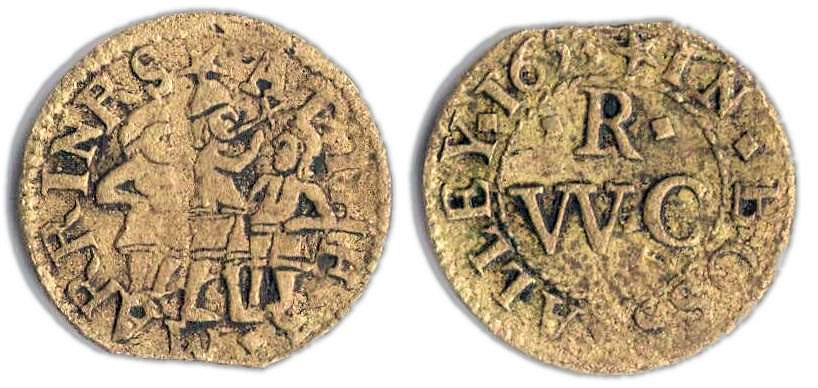
A farthing token issued in the name of the Three Mariners in Boss Alley, London

A farthing token issued in the name of the Three Mariners in Boss Alley, London

The above brass farthing token measures 15.9 mm and weighs 1.17 grams. It was issued in the name of Three Mariners  in Boss Alley in 1653. The design of the token may be formally described as follows;

Obverse: (star) AT.THE 3.MARINERS, around edge. Within centre field a depiction of three sailors standing. The centre one smoking a clay pipe (?).
Reverse: (star) IN.BOSS.ALLEY.1653 , around twisted wire inner circle. Triad W | .R. | C within.

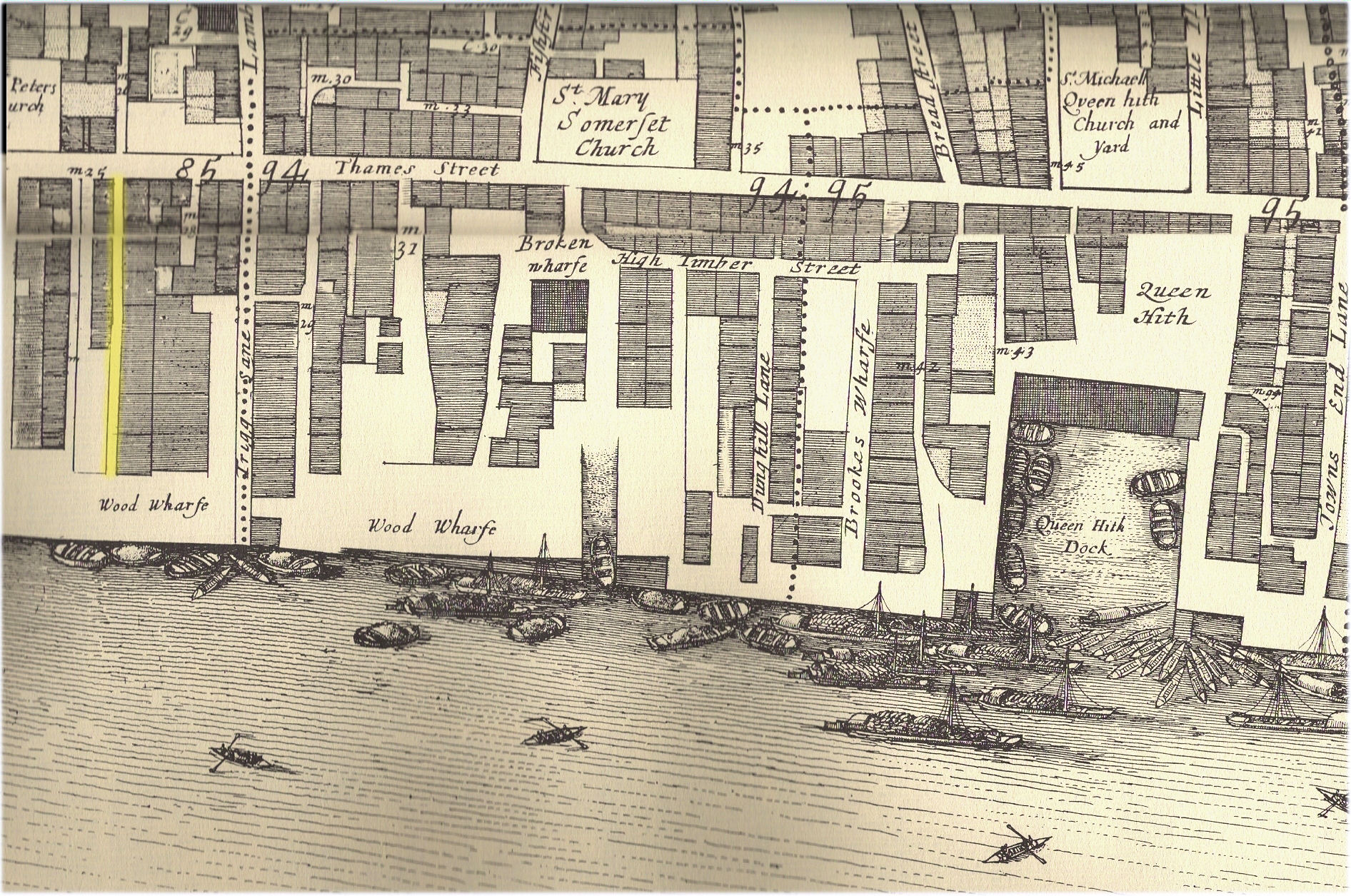
There are two alternatives for the location of Boss Alley and both lead off Thames Street. The first of these options is in Billingsgate Ward to the north of  Thames Street, east of St. Mary Hill and the south of Cross Lane. The second possibility, and the one normally accepted, is in Queenhithe Ward. This option runs off the south side of Thames Street,opposite Green Dragon Court and running parallel to Trig Lane.

Queenhithe showing the location of Boss Alley from John Ogilby & William Morgan's 1676 Map of the City of London

Queenhithe showing the location of Boss Alley from John Ogilby & William Morgan’s 1676 Map of the City of London

As yet the issuers of this farthing token , Mr. W.R. and Mrs. C.R., have not been identified. The Three Mariners was possibly a tavern. Its location between Thames Street and the north bank of the Thames, made it very accessible to passing trade moving to and from the nearby watermen’s stairs  or boat landing stage known as Trig Stairs. Here boats could be hired to cross the river or navigate to one of the many other river stairs located both up and down stream along both banks of the Thames.

The sign of the Three Mariners was common along the banks of the Thames. There are at least a dozen other examples of this sign known from 17th century London.

Leave a comment

Filed under Tokens from within the City Walls

John Parrett at the Sword & Buckler, Shire Lane, Temple Bar

A half penny token issued by John Parrett of Shire Lane, Temple Bar, London

A half penny token issued by John Parrett of Shire Lane, Temple Bar, London

The above copper half penny measures 20.8 mm and weighs 2.05 grams. It was issued in the name of John Parrett at the Sword and Buckler in Shire Lane in the district of Temple Bar Within, London in 1667.

Obverse: (rosette) IOHN.PARRETT.AT THE.SWORD , around twisted wire inner circle, within the depiction of a sword and buckler (i.e. small round shield).

Reverse: (rosette) AND.BUCKLER.SHEERE.LANE , around twisted wire inner circle. Legend within, HIS / HALFE / PENNY / 1667 in four lines.

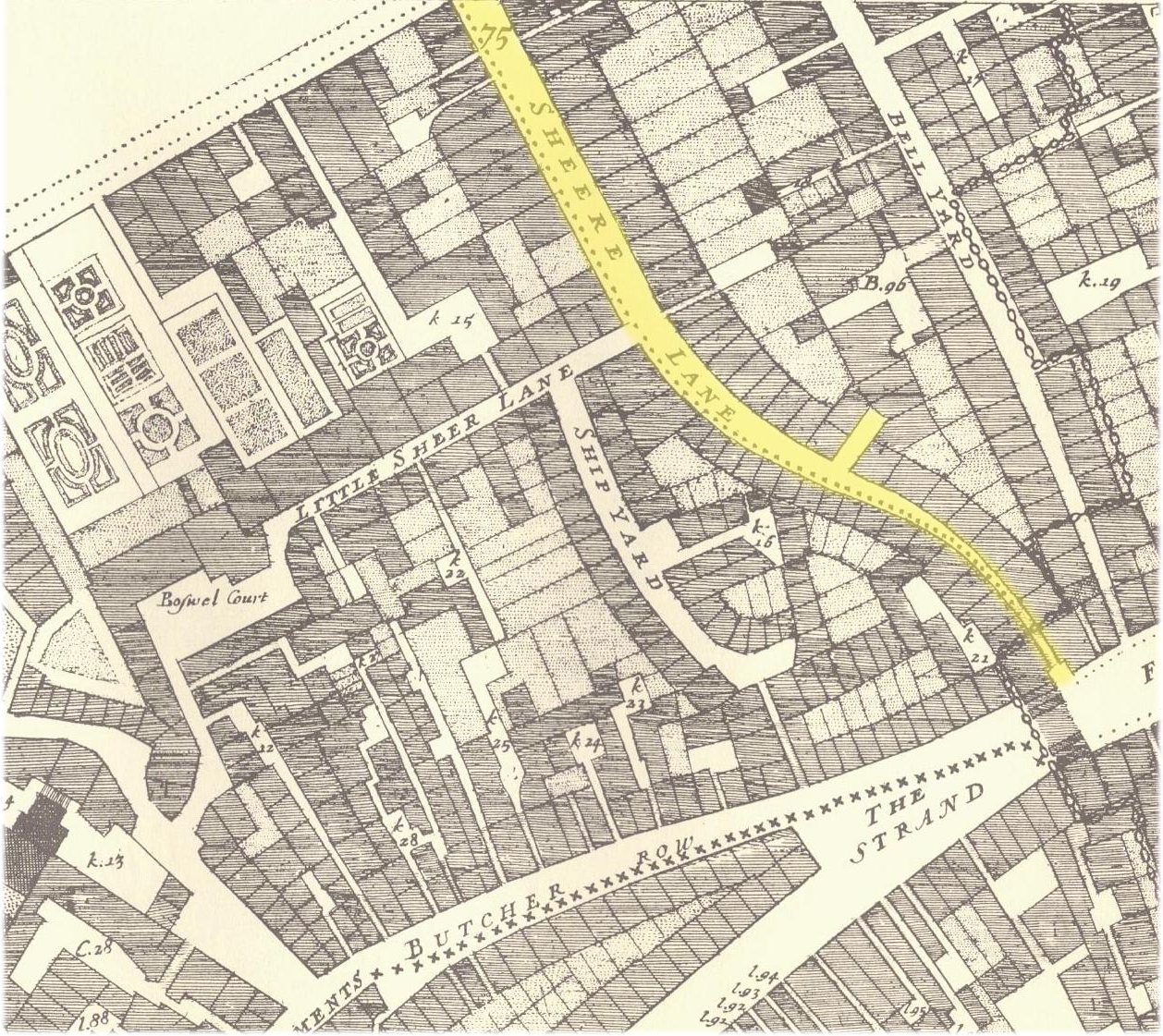
Shire (or Sheere) Lane ran north off Fleet Street from its junction with the Strand at Temple Bar.

Shire Lane from John Ogilby & William Morgan’s 1676 Map of the City of London

Shire Lane from John Ogilby & William Morgan’s 1676 Map of the City of London

From the information displayed on his token’s we can’t tell what John Parrett’s occupation was. There is also no record of him in Shire Lane in the 1666 London Hearth Tax returns. It is possible the tat the sign of the Sword and Buckler could have been used by a tavern but this is by no means certain. The sign itself may have been an indication that buckler play or so-called sword and buckler play may have been exhibited there or near by at some point in time. Sword and buckler play was once common in England, especially in the time of Elizabeth I.

Elizabeathan gentlemen engaging in sword and buckler play

Elizabeathan gentlemen engaging in sword and buckler play

By a proclamation of 1609 buckler play, bear-baiting and the singing of ballads was banded in the City of London and adjoining counties was to be prohibited and those transgressors of the new law were to be severely punished. However, on the restoration of King Charles II licences for the pastime of buckler-play and other mischievous sports were, for the payment of a fee, made available from the Master of Revels.

It is likely that it was a sword and buckler fight which Samuel Pepys described in his diary entry for 37th May 1667;

“So to my chamber, and there did some little business, and then abroad, and stopped at the Bear-garden-stairs, there to see a prize fought. But the house so full there was no getting in there, so forced to go through an alehouse into the pit, where the bears are baited; and upon a stool did see them fight, which they did very furiously, a butcher and a waterman. The former had the better all along, till by and by the latter dropped his sword out of his hand, and the butcher, whether not seeing his sword dropped I know not, but did give him a cut over the wrist, so as he was disabled to fight any longer. But, Lord! to see how in a minute the whole stage was full of watermen to revenge the foul play, and the butchers to defend their fellow, though most blamed him; and there they all fell to it to knocking down and cutting many on each side. It was pleasant to see, but that I stood in the pit, and feared that in the tumult I might get some hurt. At last the rabble broke up, and so I away to White Hall…”

In the time of John Stow, the famous Elizabethan historian of the City of London, it is recorded that every haberdasher sold bucklers. Hence it is said that the device was often associated with haberdasher.

In addition to John Parrett in Shire Lane the sign of the sword and buckler is also recorded during the period 1660 to 1720 by businesses operating at the following London addresses;

  •  Swan Alley, East Smithfield.
  • Ludgate Hill.
  • Old Fish Street, Queenhithe.

Leave a comment

Filed under Tokens from West of the City Walls

Thomas Clatworthy at the Crooked Billet (unidentified location)

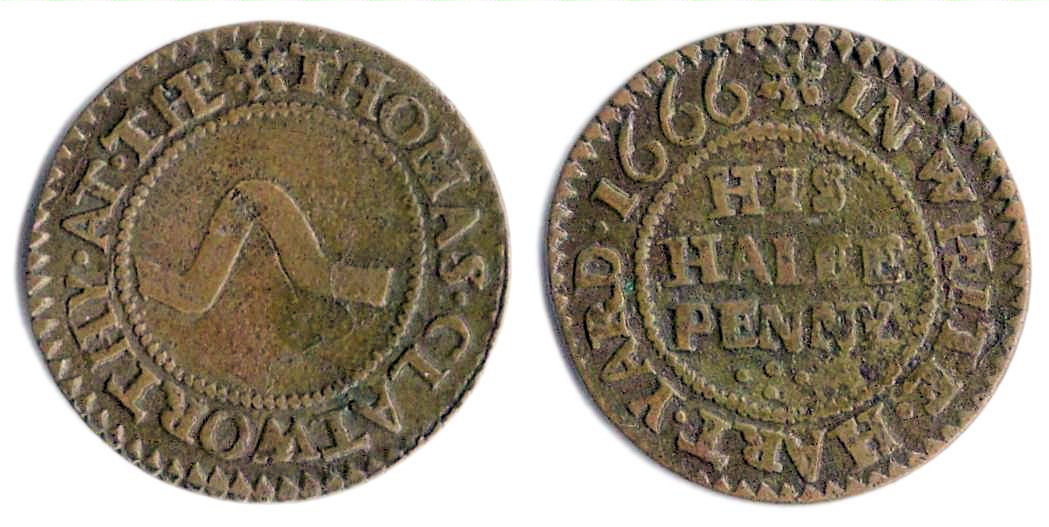
A half penny token issued by Thomas Clatworthy of White Hart Yard

A half penny token issued by Thomas Clatworthy of White Hart Yard

The above copper half penny measures 21.0 mm and weighs 2.59 grams. It was issued by Thomas Clatworthy at the sign of the Crooked Billet (i.e. a crooked stick) in White Hart Yard in 1666.

Obverse: (rosette) THOMAS.CLATWORTHY.AT.THE , around twisted wire, within the depiction of a crooked billet.

Reverse: (rosette) IN.WHITE.HART.YARD.1666 , around twisted wire inner circle HIS / HALFE / PENNY in three lines, below four dots arranged in a cross pattern.

There are still public houses and restaurants in south-east England that trade under the name of the “Crooked Billet”. A crooked billet was a bent wooden stick or cudgel which was used to play a game which was possibly a for runners of modern-day cricket.

The fact that these tokens are found in and around the vicinity of London indicates that they originate from that locality. Unfortunately the token issuer or his address has not been fully identified with any one particular location in this area. Possible contending areas for the token’s origin are as follows;

  • White Hart Yard – Stepney
  • White Hart Inn Yard – Holborn
  • White Hart Yard – Drury Lane
  • White Hart Yard – St. Martin’s Lane, Westminster
  • White Hart Yard – Tothill Street, Westminster
  • White Hart Yard – Bermondsey, Surrey
  • White Hart Yard – Southwark, Surrey

Searches of the 1662, 1664 and 1666 Hearth Tax returns for London and Westminster (made by myself) have returned no entries for anyone with the name Clatworthy or Clayworthy etc.

Leave a comment

Filed under Tokens from unidentified London Locations

John Warner at the Bell & Dolphin in Aldersgate Street

A half penny of John Warner, Aldersgate Street, London

A half penny of John Warner, Aldersgate Street, London

The above copper half penny measures 21.0 mm and weighs 2.05 grams. It was issued by John Warner of the Bell and Dolphin in Aldersgate Street, London, in 1668.

Obverse: (star) IOHN. WALNER. IN. 1668 , around twisted wire, within the depiction of a dolphin above a bell.

Reverse: (star) ALDERSGATE. STREET , around twisted wire inner circle HIS / HALFE / PENNY in three lines, below a triad comprising I | W. | A

Aldersgate Street (c.1720)

Aldersgate Street (c.1720)

Aldersgate Street ran north from the Altersgate in the city wall through the Ward of Aldersgate Without. In John Ogilby and William Morgan’s 1676 Map of the City of London a “Bell Inn” is located at the northern end of Aldersgate Street at the location highlighted by location marker No.42 in the above street plan. It is very probable that the Bell Inn can be identified with the Bell and Dolphin alluded to on John Warner’s half penny token of 1668.

In the Hearth Tax returns for Altdersgate Street in 1666 John Warner is recorded as occupying a property having 11 hearths. This is very much in-line with him being an innkeeper. Based on the triad of his plus his wife’s initials on the reverse of his token it is possible that his wife’s name was Ann.

Leave a comment

Filed under Tokens from North of the City Walls

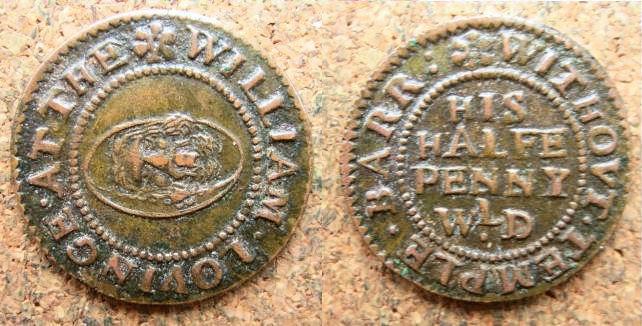
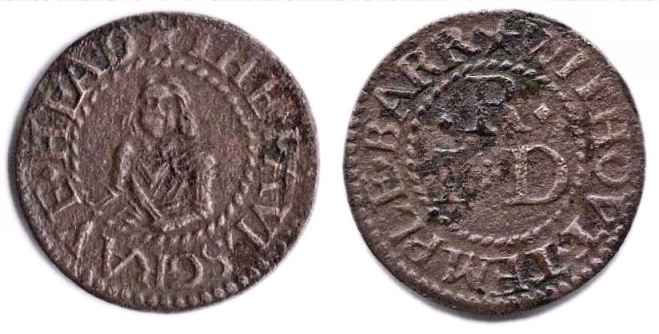
William Lovinge, Temple Bar Without, Westminster

A half penny token of William Lovinge of Temple Barr Without

A half penny token of William Lovinge of Temple Barr Without

The above copper half penny measures 20.7 mm and weighs 2.19 grams. It was issued in the name of the Baptist’s Head in the district of Temple Bar Without, Westminster.

Obverse: (rosette) WILLIAM.LOVINGE.AT THE , around twisted wire inner circle, within the depiction of the John the Baptist’s head on  dish.

Reverse: (rosette) WTHHOVT.TEMPLE.BARR: , around twisted wire inner circle, HIS / HALFE / PENNY in three lines, below a triad comprising W | L. | D , within.

The Baptist’s Head was a common London sign prior to the Henry VIII’s conversion to Protestantism. It is not known in this case if the sign was that of a tavern or alternative business. The exact location of the business is also not know but presumably it lay off The Strand.

The Strand & Temple Bar Without, Westminster

The Strand & Temple Bar Without, Westminster

A similar token was issued John Lawton who also traded at the sign of the Baptist’s Head in Temple Bar Without. Stylistically this appears to be earlier in date than that described above which most likely dates to the period 1665 to 1670.

Leave a comment

Filed under Tokens from West of the City Walls

Thomas Stares in the Bulwark, Tower Hill

A farthing token of Thomas Stares in the Bulwark, Tower Hill

A farthing token of Thomas Stares in the Bulwark, Tower Hill

The above copper farthing measures 15.6 mm and weighs 0.95 grams. It was issued in the name of Thomas Stares of the Bulwark, Tower Hill in 1653.

Obverse: (mullet) THOMAS STARES, around twisted wire inner circle, triad T |. S.| .E in two lines within.

Reverse: (mullet) IN.THE.BVLLWORKE , around twisted wire inner circle, 1653 with (rosette) above and below.

This token has a small radius semi-circular cut removed from its outer edge. This may be a cancellation mark, a deliberate defacement making the token worthless. It has been postulated that such cancellation marks (and others which are manifest as defacing piercings) were applied to the tokens in 1672 when they were made illegal by Royal proclamation , or at the death of the issuer or closure of their business.

The Bulwark was the outer most enclosure on the approach to the Tower of London. Formerly this area was part of Stepney. Its construction began c.1480 and its demolition began in 1668 although the shops within and/or around it are reported to have been cleared by 1666. The outer side of the Bulwark was part of Tower Hill. It was entered by Bulwark Gate and exited via Lion Gate as part of the final approach to the Tower Gate of the Tower of London.

The Tower of London (c.1600) indicating the area of the Bulwark between the Lion and the Bulwark Gates

The Tower of London (c.1600) indicating the area of the Bulwark between the Lion and the Bulwark Gates

Based on Thomas’s wife having the a fist name beginning with the letter “E” it can be assumed that the triad of initials on this token represent those of Thomas and Elizabeth Stares. There is no record of a Thomas Stares in the Hearth Tax return for London for 1660s. However, there is a Mrs. Stares (widow) recorded as paying  tax on a single hearth in the Limehouse district of Stepney in 1666. This could well be Thomas’ widow.

Leave a comment

Filed under Tokens from within the City Walls

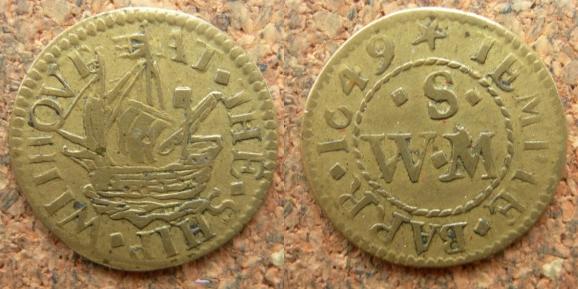
The Ship Tavern, Temple Bar Without, Westminster

Farthing token from the Ship Tavern, Temple Bar Without, Westminster

Farthing token from the Ship Tavern, Temple Bar Without, Westminster

The above brass farthing measures 16.4 mm and weighs 1.12 grams. It was issued in the name of a Mr. W. S. & Mrs. M. S. who traded at the sign of the Ship (presumed to have been a tavern) in the Temple Bar Without district of Westminster in 1649. This makes it one of the earliest farthings to be issued in the 17th Century token series.

Obverse: AT.THE.SHIP.WITHOVT , around edge. Within, A three-masted ship sailing left.

Reverse: (star) TEMPLE.BARR.1649 , around twisted wire inner circle, triad comprising W | .S. | .M , within.

The Ship tavern was situated in Ship Yard, a lane which ran off the south side of Little Sheer Lane  and which to the south was connected to The Strand by an alley. This alley was located on the opposite side of The Strand to entrance to Palsgrave’s Head Court.

Location of the Ship Yard from John Ogilby & William Morgan’s 1676 Map of the City of London

Location of the Ship Yard from John Ogilby & William Morgan’s 1676 Map of the City of London

There is a reference to the Ship Inn near Temple Bar  as early as 1571.

In 1654 the engraver William Faithorne (1616 to 1691) establish a print shop at “the Sign of the Ship within Temple Bar”. By 1662 he had moved his premisses to a shop “next to the Sign of the Drake without Temple Bar”.

A view from the south west of a 17th Century three bayed, four storey house in Ship Yard (1761)

A view from the south west of a 17th Century three bayed, four storey house in Ship Yard (1761)

Leave a comment

Filed under Tokens from West of the City Walls

Palsgave’s Head Tavern, Temple Bar Without, Westminster

A farthing token from the Palsgrave's Head tavern, Temple Bar Without

A farthing token from the Palsgrave’s Head tavern, Temple Bar Without

The above copper farthing measures 16.2 mm and weighs 0.76 grams. It was issued in the name of the Palsgrave’s Head tavern in the district of Temple Bar Without, Westminster.

Obverse: (star) THE.PAVLSGRAVE.HEAD , around twisted wire inner circle, depiction of the Palsgrave (i.e. the Elector Palatine of the Rhine) within.

Reverse: (star) WTHHOVT.TEMPLE.BARR , around twisted wire inner circle, triad comprising I | .R. | (rosette) D , within.

The Palsgraves Head tavern was situated in Palsgrave Place, a narrow paved court which ran off the south side of The Strand, about half way between Temple Bar and the St. Clement Danes Church. The court and tavern took its name from the sign of the Palsgrave’s Head.

Location of the Palsgrave Head Court from John Ogilby & William Morgan’s 1676 Map of the City of London

Location of the Palsgrave Head Court from John Ogilby & William Morgan’s 1676 Map of the City of London

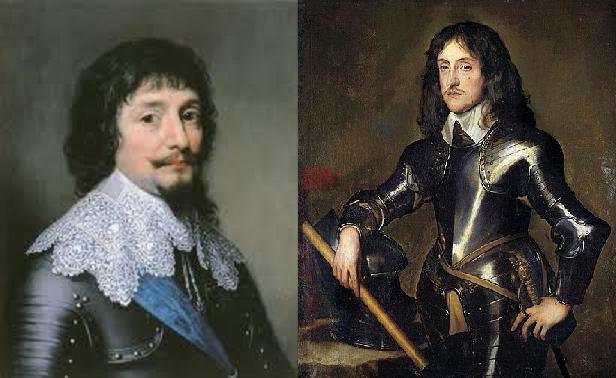
The title of “Palsgrave” was an alternative to that of Count or Elector Palatine of the Rhine (a former territory of the Holy Roman Empire).  The Palgrave in question has traditionally been associated with Frederick V (1596 to 1632) who held the tile of Elector Palatine between 1610 to 1623 and briefly that of King of Bohemia between 1619 and 1620. In 1612 Frederick married the Princess Elizabeth, the daughter of James I. A more recent alternative identification of the Palsgrave in question has been suggested as Charles Louis (1617 to 1680), the son of Frederick and Elizabeth and elder brother to Prince Rupert of the Rhine, the celebrated Royalist General of the English Civil War.

After the death of his older brother in 1629, and of his father in 1632, Charles Louis became Palsgrave, inheriting his father’s possessions in the Electorate of the Palatinate. Along with his younger brother Prince Rupert of the Rhine, he spent much of the 1630s at the court of his uncle, King Charles I, in England, hoping to enlist English support for his cause. The young Elector Palatine was largely unsuccessful in this, and became gradually estranged from the King, who feared that Charles Louis might become a focus for opposition forces in England. Indeed, the political crisis leading up to the outbreak of the English Civil War, Charles Louis had considerable sympathy for the parliamentary leaders, especially the Earl of Essex, feeling them more likely to come to the aid of the Palatinate on the continent. Although Charles Louis was involved in the early stages of the Civil War with his uncle, he was mistrusted for his parliamentary sympathies, and soon returned to his mother in The Hague. There he distanced himself from the royalist cause in the Civil War.

In 1644, Charles Louis returned to England at the invitation of Parliament. He took up residence in the Palace of Whitehall, even though his brothers, Rupert and Maurice, were Royalist generals. Contemporaries (including King Charles) and subsequent generations believed that Charles Louis’ motive in visiting Roundhead London was that he hoped that Parliament would crown him King, in place of his uncle. Charles Louis’ endorsement of the Parliamentary party was a cause of enmity between uncle and nephew, and when a captive Charles I met his nephew once again in 1647, the elder Charles accused the Prince of angling after the English throne. Charles Louis was still in England in October 1648 when the Peace of Westphalia restored the Lower Palatinate to him. He remained in England long enough to see the execution of his uncle Charles I in January 1649. He returned to the Rhine Land the same year never to return to England.  His English relations and mother never forgave him for his Parliamentary alliances during the Civil War.

If a reference to Palsgrave Place or Court could be found prior to the death of Frederick V in 1632 the true identity of the particular Palsgrave refered to in the 17th century sign board could be confirmed. Contemporary portraits of Frederick and Charles Louis do note rule out either man as that featured in the original sign and reproduced on the above token. However, on balance the portrait of the latter does appear to most resemble that depicted on the token.
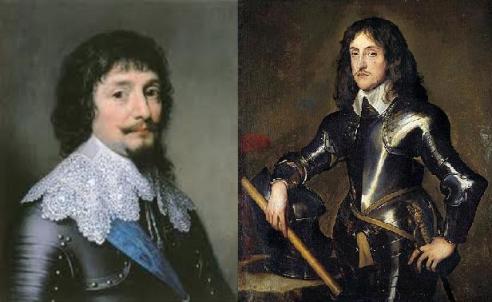
Portraits of the Palsgraves Frederick (left) & Charles Louis (right)

Portraits of the Palsgraves Frederick (left) & Charles Louis (right)

The farthing token looks typical of the style of others which can be dated to the 1650s. A further half penny token exists m this tavern which appears slightly later in dated (c. late 1650s to mid 1660s).
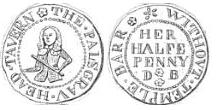
A half penny token issued in the name of the Palsgrave's Head Tavern

A half penny token issued in the name of the Palsgrave’s Head Tavern

It is possible that the above half penny token was issued by the widow of the landlord (Mr. I. R.) who issued the original farthing token after she had re-married as both women have the same Christian name initial (i.e. “D”).

Leave a comment

Filed under Tokens from West of the City Walls

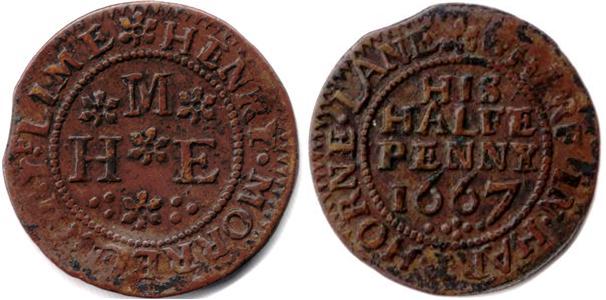
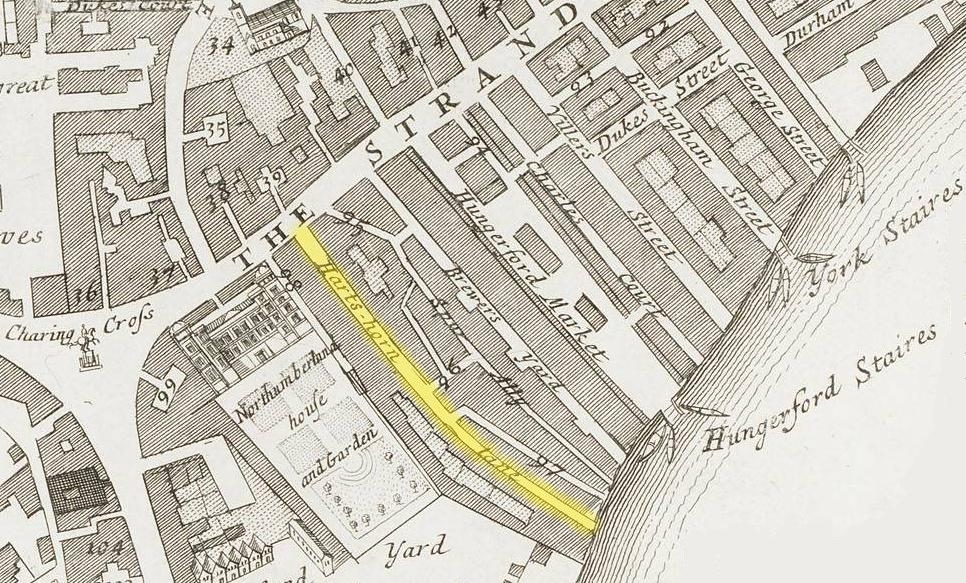
Henry Morrell in Hartshorne Lane, Westminster

A half penny token of Henry Morrell of Hartshorne Lane, Westminster

A half penny token of Henry Morrell of Hartshorne Lane, Westminster

The above copper half penny measures 21.0 mm and weighs 1.22 grams. It was issued in the name of Henry Morrell.

Obverse: (rosette) HENRY.MORRELL.AT.YE.LIME , around twisted wire inner circle, H M E inter spaced with three rosettes with two sets of three dots arranged in triangular form below with a fourth rosette in between.

Reverse: (rosette) WHARF.IN.HART.HORNE.LANE , around twisted wire inner circle, HIS/ HALFE /PENNY /1667 in four lines plus six dits arranged in an elongated cross pattern within.

Hartshorne Lane, Westminster (1720)

Hartshorne Lane, Westminster (1720)

Lime wharf was a but busy wharf on the River Thames at the bottom of Harshorne Lane, which ran south off the Strand to the west of where the present day Charing Cross Station is located. This part of the city was outside of the area affected by the Great Fire of 1666.

As yet I’ve been unable to find any record as to the trade or further background details of Henry Morrell or his wife whose name , based on the reverse triad of initials, was presumably Elizabeth? Henry Morrell is not listed in the Hearth Tax records for 1662, 1664 or 1666. However, there is a record of the marrige of a Henry Morrell and an Elizabeth Estridge in the parish registers of St. Gregory by St Paul’s on 12th May 1664.

Leave a comment

Filed under Tokens from West of the City Walls

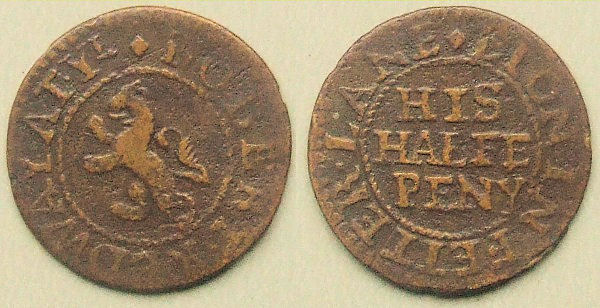
Robert Redway at the Red Lion in Fetter Lane

A  half penny token of Robert Redway of Fetter Lane, London.

A half penny token of Robert Redway of Fetter Lane, London.

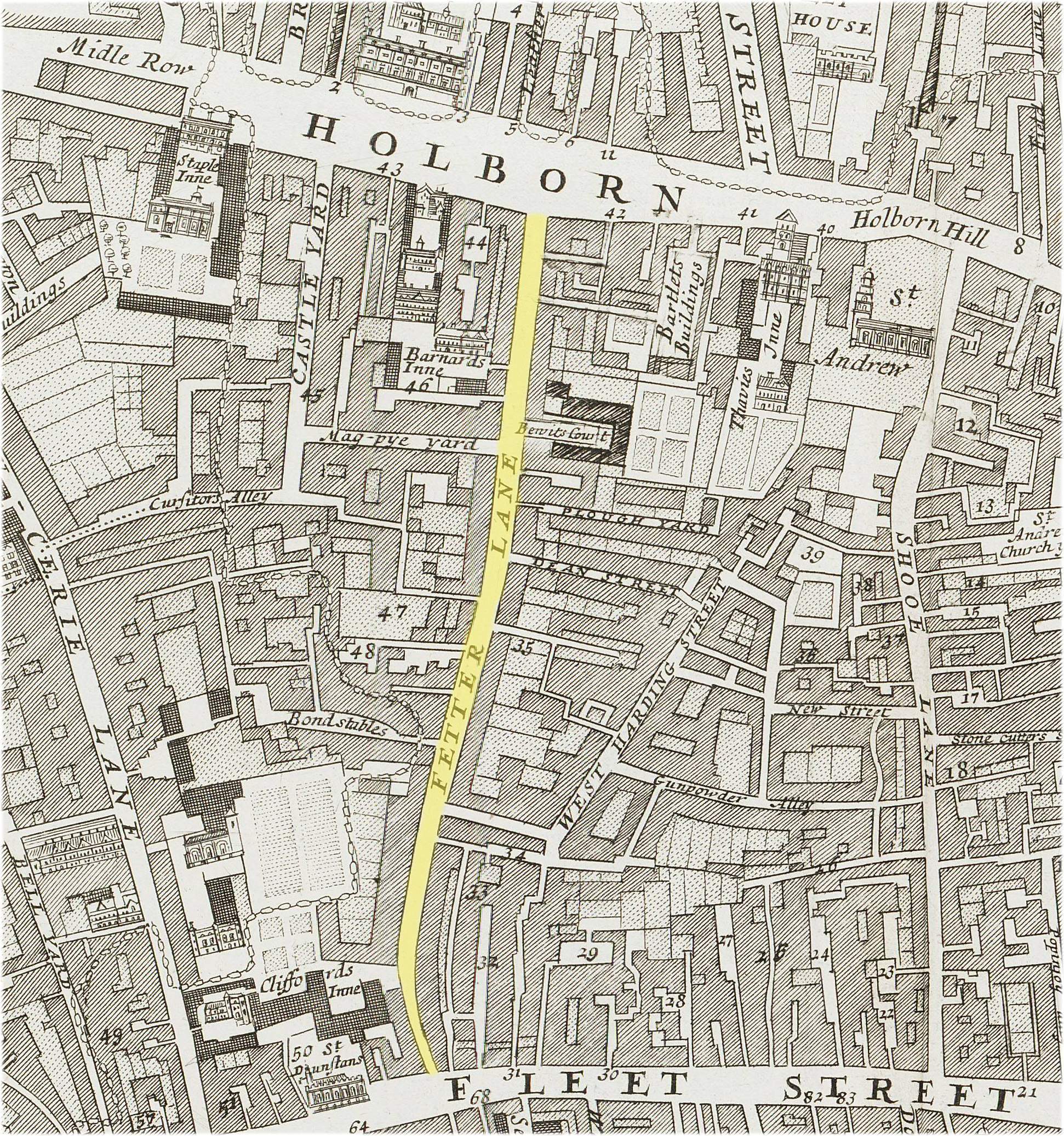
The above copper half penny measures 17.9 mm and weighs 1.51 grams. It was issued in the name of Robert Redway, the inn keeper at the Red Lion in Fetter Lane. Fetter Lane ran north off Fleet Street to Holborn through the ward of Farringdon Without.

Obverse: (diamond) ROBERT.REDWAY.AT.YE , around twisted wire inner circle, rampant lion left.

Reverse: (diamond) LION.IN.FETTER.LANE , around twisted wire inner circle, HIS HALFE PENY in three lines within.

Fetter  Lane district of the Farrindon Without Ward of the city of London (c.1720)

Fetter Lane district of the Farrindon Without Ward of the city of London (c.1720)

According to the Hearth Tax returns of 1666 Robert Redway lived in the Middle Precinct of Fetter Lane in a dwelling (presumably the Red Lion ) having 7 hearths. Fetter Lane was fully consumed by the Great Fire of 1666. Interestingly in the survey of building sites laid out in London after the Great Fire there are three separate plots staked out in Fetter Lane in the name of Robert Redway. The first of these was on 20th May 1667 and was adjacent to the Mercers’ Company and the Vicarage House. The second two were allotted on 8th June 1667.

According an entry attributed to Sir Thomas Blidworth (MP) in a publication by William Bedloe of 1679 (Narrative and impartial discovery of the horrid Popish Plot) separate cases of arson were discovered on both the 3rd and 4th of August 1670 in rooms belonging to of the Red Lion, an establishment run by Robert Redway in Fetter Lane.  The perpetrators of these crimes were not known but it is inferred by the publication that they were Catholic agents looking to raise the city to the ground by the setting of fires as had been suspected to have been the cause of the Great Fire of 1666.

Leave a comment

Filed under Tokens from within the City Walls