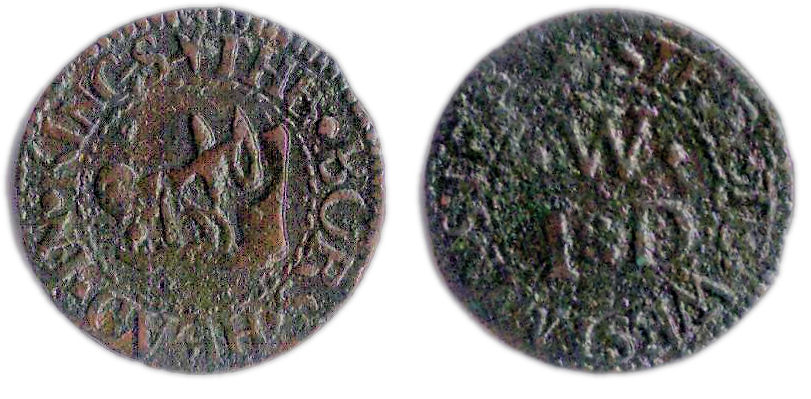
A farthing token issued in the name of the Boar’s Head in King Street, Westminster
The above copper farthing token measures 15.7 mm and weighs 0.94 grams. It was issued in the name of Blue Boar’s Head tavern which was located on the west side of King Street in St. Margaret’s Parish, Westminster. The design of the token may be formally described as follows;
Obverse: (star) THE.BORS.HEAD.IN.KINGS, around twisted wire inner circle, boar’s head looking left within.
Reverse: (star) STREETE.WESTMINSTER , around twisted wire inner circle, triad comprising I |.W.|(rosette) D within.
The initials of the couple that ran The Blue Boar’s Head tavern at the time the token was issued, a Mr. “J/I.W.” and his wife Mrs.” D.W.” as yet have not been identified.
The style of this farthing token would suggest an early date in the series, possibly 1650 to 55.
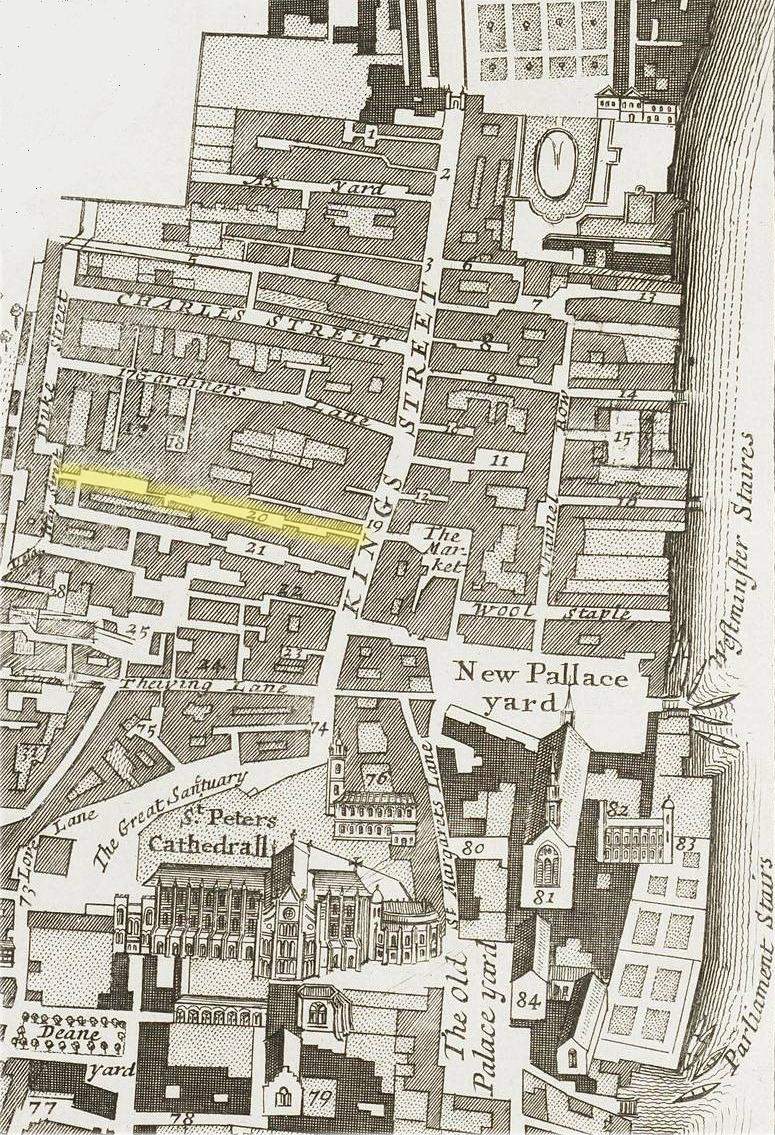
The location of the Blue Boar’s Head Yard off King Street, Westminster (c.1720)
The Blue Boar’s Head was of the oldest established tavern in the Parish of St. Margaret’s, Westminster. It dated back to the late 14th Century. Extensions in 1396 and 1401 gave it 16 bedchambers which were sumptuously furnished. It was located adjacent to a yard which bore its name and which connected the narrow and congested King Street on its eastern side with De La Haye Street to its west.
Oliver Cromwell, the Lord Protector, gave a suite of apartments in King Street to his mother. She lived here until her death in 1654. These apartments are understood to have been located on the north side of the Blue Boar’s Head Yard adjacent to the tavern.
Owing to its narrowness and want of light and air, and the crowded courts by which it was hemmed in on either side, King Street was among the first parts of Westminster to suffer from the plague in 1665. On its appearance, so close to the gates of the royal palace, Charles II and his courtiers, left Whitehall for the comparative safety of Oxford.
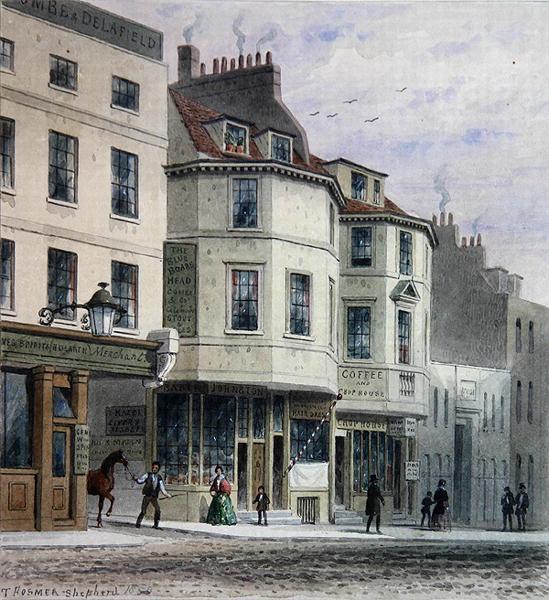
The Blue Boar’s Head – A mid 19th century view of the inn post its re-building in the mid 18th century
The construction of Westminster Bridge and Great George Street in 1750 led to the demolition of the old Blue Board’s Head tavern and its stable yard, which were rebuilt a short distance to the north at what was to become 34, Kings Street, Westminster. It was finally demolished, along with what was left of King Street, in 1899.
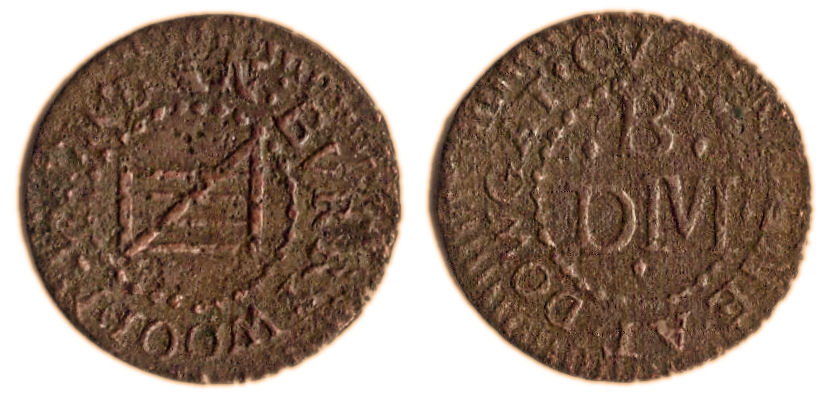
A farthing token issued in the names of Daniel Burry of Cousin Lane, London
The above copper farthing token measures 15.9 mm and weighs 0.76 grams. It was issued in the name of Daniel Burry of Cousin Lane, Dowgate. Cousin Lane was located in the Dowgate Ward of the city and ran off the south side of Thames Street down to a slip way and wharf on the River Thames. This lane formed the western boundary of Steelyard (or Steel / Still Yard) and was located in an area containing several warehouses and goods storage yards all of which backed onto the north bank of the River Thames.
The design of the token may be formally described as follows;
Obverse: .DAN . BURRY WOODMVNGR , around twisted wire inner circle, depiction of four barred gate within.
Reverse: .CVZEN LANE . AT . DOWGAT, around twisted wire inner circle, a triad within reads D|.B.|M below (.)
On stylistic grounds this farthing token appears to date from the mid 1650s t0 the early 1660s.
Cousin Lane from John Ogilby & William Morgan’s 1676 Map of the City of London
Daniel Burry (or possibly Berry) was a woodmunger, or domestic fuel (i.e. wood and coal) salesman. He probably traded at the sign of the gate in the terrace row which ran along Cousin Lane and backed onto Dowgate Dock. The properties on the eastern side of Cousin lane backed onto Steel Yard. In the 1662 Hearth Tax returns his property is listed as having 5 hearths.
On 2nd September 1666 this area of the city was destroyed during the first morning of the Great Fire of London. In the first of his famous diary entries (reproduced in part below) which document the progress of the fire Samuel Pepys described its progress that first morning and how he witnessed it engulf the warehouses and storage yards in the vicinity of Steel Yard. These contained a plethora of combustible goods including, brandy and spirits, rope and cord, tallow and wax, wool and cloth, pitch and tar plus coal and (in the case of our particular token issuer) wood.
“(Lord’s day). Some of our mayds sitting up late last night to get things ready against our feast to-day, Jane called us up about three in the morning, to tell us of a great fire they saw in the City. So I rose and slipped on my nightgowne, and went to her window, and thought it to be on the backside of Marke-lane at the farthest; but, being unused to such fires as followed, I thought it far enough off; and so went to bed again and to sleep. About seven rose again to dress myself, and there looked out at the window, and saw the fire not so much as it was and further off. So to my closett to set things to rights after yesterday’s cleaning. By and by Jane comes and tells me that she hears that above 300 houses have been burned down to-night by the fire we saw, and that it is now burning down all Fish-street, by London Bridge. So I made myself ready presently, and walked to the Tower, and there got up upon one of the high places, Sir J. Robinson’s little son going up with me; and there I did see the houses at that end of the bridge all on fire, and an infinite great fire on this and the other side the end of the bridge; which, among other people, did trouble me for poor little Michell and our Sarah on the bridge. So down, with my heart full of trouble, to the Lieutenant of the Tower, who tells me that it begun this morning in the King’s baker’s house in Pudding-lane, and that it hath burned St. Magnus’s Church and most part of Fish-street already. So I down to the water-side, and there got a boat and through bridge, and there saw a lamentable fire. Poor Michell’s house, as far as the Old Swan, already burned that way, and the fire running further, that in a very little time it got as far as the Steeleyard, while I was there. Everybody endeavouring to remove their goods, and flinging into the river or bringing them into lighters that layoff; poor people staying in their houses as long as till the very fire touched them, and then running into boats, or clambering from one pair of stairs by the water-side to another. And among other things, the poor pigeons, I perceive, were loth to leave their houses, but hovered about the windows and balconys till they were, some of them burned, their wings, and fell down. Having staid, and in an hour’s time seen the fire: rage every way, and nobody, to my sight, endeavouring to quench it, but to remove their goods, and leave all to the fire, and having seen it get as far as the Steele-yard, and the wind mighty high and driving it into the City; and every thing, after so long a drought, proving combustible, even the very stones of churches…..”
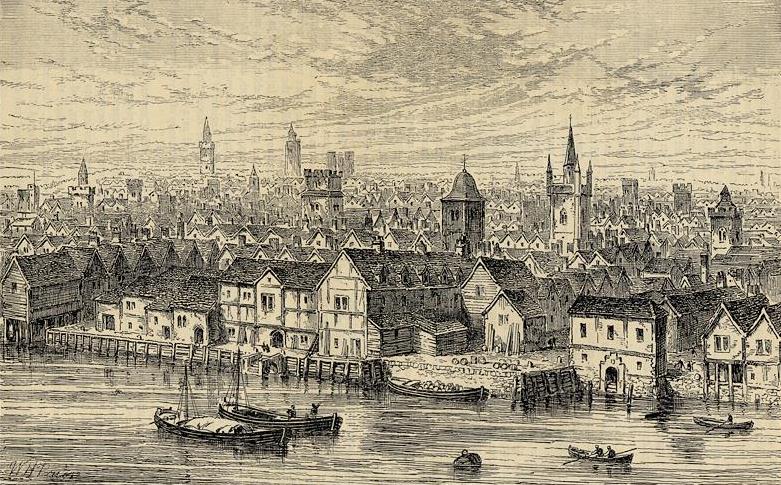
The neighbourhood of Steel Yard on the north bank of the River Thames, London. (c.1540).
After the Great Fire it appears that Daniel Burry re-built his property in Cousin Lane and is recorded as having paid for the staking out of foundations associated with the re-building of at least four other properties in the vicinity of Dowgate. The receipts, each for 6s and 8d, for staking out these various properties were received from Daniel Burry by the city authorities on the following dates;
Cozen (Cousin) Lane, near Dowgate – 14th December 1667
Dowgate Hill, at ye west Corner Hill – 7th April 1668
Dowgate Hill, at ye west Corner Hill – 7th April 1668
Dowgate Hill, east side – 4th September 1668
Dowgate Hill, east side – 4th September 1668
The last four of these foundations were surveyed by the famous Robert Hooke under his post Great Fire role of Surveyor of the City of London.
No further information has yet come to light regarding Daniel Burry or his wife (possibly Margaret or Mary) or business post the Great Fire although the present writer has been discovered a burial register entry, dated 23rd February 1698, for a Daniel Burry in the parish registers of All-Hallows-the-Great. This church was situated on Thames Street just east of Steel Yard. It was one of the many parish churches re-built by Sir Christopher Wren after the Great Fire. This church would almost certainly have been that to which Daniel Burry, the woodmunger of Cousin Lane from the 1650s and 60s, would have attended.
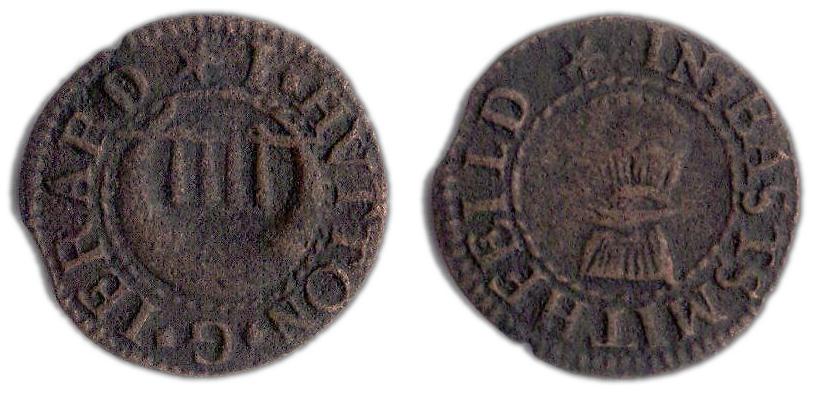
A farthing token issued in the names of Jerrard and Hutton, tradesmen in East Smithfield, London
The above copper farthing token measures 15.4 mm and weighs 0.81 grams. It was issued in the joint names of John Hutton and G. Jerrard and of East Smithfield, an area to the immediate east of the Tower of London which runs along the southern boundary of the parish of St. Botolph without Aldgate and the northern edge of the parish of St. Katherine’s by The Tower.
This token is an interesting example of two persons, apparently of different trades, were jointly responsible for issuing a token in both of their names.
The design of the token may be formally described as follows;
Obverse: (star) I.HVTTON. G.IERARD , around twisted wire inner circle, depiction of four candles suspended from a cord strung between the ends of a crescent moon.
The first person listed on the obverse of the token, i.e. J. Hutton, has been identified as John Hutton who, given the appearance of a string of candles on the obverse of the token, may have been a tallow chandler who possibly operated at the sign of the Half Moon in East Smithfield. In the Hearth Tax returns for 1666 there is a listing for a John Hutton paying tax on 3 hearths “street side” in St. Botolph Aldgate.
The second individual listed, G. Jerard, has not been identified. It has been postulated that the reverse sign of a wheatsheaf may imply that he was a baker. Alternatively he may have been alternatively employed in a different trade operating from the sign of the Wheatsheaf in East Smithfield. The sign of the Wheatsheaf in combination with other objects has been noted as being used by haberdashers, lacemen, woolen draper. mercers and sundry others by Bryant Lillywhite in his book “London Signs”.
A farthing token issued in the name of The Hercules Pllars in Fleet Street, London
The above brass farthing token measures 15.8 mm and weighs 0.93 grams. It was issued in the name of The Hercules Pillars Tavern in Fleet Street, London.
The design of the token may be formally described as follows;
Obverse: (star) THE.HERCVLVS.PILLERS , around twisted wire inner circle, depiction of Hercules with a rope wrapped around his waist pushing against two pillars. Reverse: (star) IN.FLEET.STREETE.WESTMINSTER , around twisted wire inner circle, triad I /. S . / .M within.
Stylistically this undated farthing token likely dates to the mid 1650s and was probably struck by David Rammage at the Tower Mint. The initials of the couple that ran The Hercules Pillars at the time this token was issued (i.e. Mr. “J (or I).M” and his wife Mrs.”S.M.”) have not been positively identified although one researcher has proposed that those of the landlord belong to a Mr. John Symons.
From c.1657 to at least 1666 The Hercules Pillars tavern was run by Edward Oldham who issued his own half penny token in the names of himself and his wife. stylistically this later token appears to date to the mid 1660s. In the 1666 Hearth Tax return the tavern appears to have 17 hearths.
The location of Hercules Pillar Alley off the south side of Fleet Street from John Ogilby & William Morgan’s 1676 Map of the City of London
The Hercules Pillars was built-in the time of King James I and was a tavern of great repute in the 17th century with lovers of good living. It stood at the head of Hercules Pillar Alley on the south side of Fleet Street, south-west of St. Dunstan’s Church and north of Temple Churchyard. In John Strype‘s Survey of London (1720) he describes Hercules Pillars Alley as;
“Hercules Pillars Alley, but narrow, and altogether inhabited by such as keep Public Houses for Entertainment, for which it is of Note.”
In a letter of advice to a foreigner visiting England in 1679 the philosopher John Loche sates the following on the subject of “the home made ales of England”;
“There are also several sorts of compound ales, as cock-ale, wormwood-ale, lemon-ale, scurvy-grass-ale, colledge-ale etc. These are to be had at Hercules’ Pillars, near the Temple.”
The Hercules Pillars tavern was a popular haunt of Samuel Pepys . He mentions it in 26 separate entries in his famous diaries. These entries are listed chronologically below.
11th October 1660
“Here, in the Park, we met with Mr. Salisbury, who took Mr. Creed and me to the Cockpitt to see “The Moore of Venice,” which was well done. Burt acted the Moore; ‘by the same token, a very pretty lady that sat by me, called out, to see Desdemona smothered. From thence with Mr. Creed to Hercules Pillars, where we drank and so parted, and I went home.”
30th October 1660
“In the afternoon, to ease my mind, I went to the Cockpit all alone, and there saw a very fine play called “The Tamer Tamed;” very well acted. That being done, I went to Mr. Crew’s, where I had left my boy, and so with him and Mr. Moore (who would go a little way with me home, as he will always do) to the Hercules Pillars to drink, where we did read over the King’s declaration in matters of religion, which is come out to-day, which is very well penned, I think to the satisfaction of most people.”
4th January 1660/61
“After dinner Mr. Moore and I to the Theatre, where was “The Scornful Lady,” acted very well, it being the first play that ever he saw. Thence with him to drink a cup of ale at Hercules Pillars, and so parted.”
30th July 1661
“So in Fleet Street I met with Mr. Salisbury, who is now grown in less than two years’ time so great a limner (i.e. a portrait painter or book illuminator) thathe isbecome excellent, and gets a great deal of money at it. I took him to Hercules Pillars to drink, and there came Mr. Whore (whom I formerly have known), a friend of his to him, who is a very ingenious fellow, and there I sat with them a good while, and so home …..”
27th March 1663
“Thence I to the Exchequer again, and thence with Creed into Fleet Street, and calling at several places about business; in passing, at the Hercules pillars he and I dined though late, and thence with one that we found there, a friend of Captain Ferrers I used to meet at the playhouse, they would have gone to some gameing house, but I would not but parted, and staying a little in Paul’s Churchyard, at the foreign Bookseller’s looking over some Spanish books….”
29th October 1663
“…Being wearied with looking upon a company of ugly women, Creed and I went away, and took coach and through Cheapside, and there saw the pageants, which were very silly, and thence to the Temple, where meeting Greatorex, he and we to Hercules Pillars, there to show me the manner of his going about of draining of fenns, which I desired much to know, but it did not appear very satisfactory to me, as he discoursed it, and I doubt he will faile in it. Thence I by coach home….”
21st June 1667
“Thence homewards, calling at my Tailor’s to bespeak some coloured clothes, and thence to Hercules Pillars, all alone, and there spent 6d. on myself, and so home and busy all the morning. At noon to dinner, home….”
6th February 1667/68
“At last I did find my wife staying for me in the entry; and with her was Betty Turner, Mercer, and Deb. So I got a coach, and a humour took us, and I carried them to Hercules Pillars, and there did give them a kind of a supper of about 7s., and very merry, and home round the town, not through the ruines; and it was pretty how the coachman by mistake drives us into the ruines from London-wall into Coleman Street: and would persuade me that I lived there.”
20th April 1668
“Thence with Creed, thinking, but failed, of dining with Lord Crew, and so he and I to Hercules Pillars, and there dined, and thence home by coach….”
22nd April 1668
“Up, and all the morning at my office busy. At noon, it being washing day, I toward White Hall, and stopped and dined all alone at Hercules Pillars, where I was mighty pleased to overhear a woman talk to her counsel how she had troubled her neighbours with law, and did it very roguishly and wittily.”
28th April 1668
“Thence with Creed to Hercules Pillars by the Temple again, and there dined he and I all alone, and thence to the King’s house….”
1st May 1668
“Thence I by coach to the Temple, and there set him down, and then to Sir G. Carteret’s to dine, but he not being at home, I back again to the New Exchange a little, and thence back again to Hercules Pillars, and there dined all alone, and then to the King’s playhouse, and there saw “The Surprizall…”
2nd May 1668
“At noon with Lord Brouncker in his coach as far as the Temple, and there ‘light and to Hercules Pillars, and there dined, and thence to the Duke of York’s playhouse, at a little past twelve, to get a good place in the pit……”
13th May 1668
“Thence, at noon, to Hercules Pillars, and there dined all alone, and so to White Hall, some of us attended the Duke of York…”
23rd June 1668
“So I away with my wife and Deb., whom I left at Unthanke’s, and so to Hercules Pillars, and there we three supped on cold powdered beef, and thence home and in the garden walked a good while with Deane, talking well of the Navy miscarriages and faults. So home to bed.”
31st August 1668
“Up, and to my office, there to set my journal for all the last week, and so by water to Westminster to the Exchequer, and thence to the Swan, and there drank and did baiser la fille there, and so to the New Exchange and paid for some things, and so to Hercules Pillars, and there dined all alone, while I sent my shoe to have the heel fastened at Wotton’s, and thence to White Hall to the Treasury chamber, where did a little business, and thence to the Duke of York’s playhouse…..”
9th November 1668
“So I staid about the Court a little while, and then to look for a dinner, and had it at Hercules-Pillars, very late, all alone, costing me 10d. And so to the Excise Office, thinking to meet Sir Stephen Fox and the Cofferer….”
18th November 1668
“Lay long in bed talking with my wife, she being unwilling to have me go abroad, saying and declaring herself jealous of my going out for fear of my going to Deb., which I do deny, for which God forgive me, for I was no sooner out about noon but I did go by coach directly to Somerset House, and there enquired among the porters there for Dr. Allbun, and the first I spoke with told me he knew him, and that he was newly gone into Lincoln’s Inn Fields, but whither he could not tell me, but that one of his fellows not then in the way did carry a chest of drawers thither with him, and that when he comes he would ask him. This put me into some hopes, and I to White Hall, and thence to Mr. Povy’s, but he at dinner, and therefore I away and walked up and down the Strand between the two turnstiles, hoping to see her out of a window, and then employed a porter, one Osbeston, to find out this Doctor’s lodgings thereabouts, who by appointment comes to me to Hercules pillars, where I dined alone, but tells me that he cannot find out any such, but will enquire further.”
23rd November 1668
“Thence with W. Hewer, who goes up and down with me like a jaylour, but yet with great love and to my great good liking, it being my desire above all things to please my wife therein. I took up my wife and boy at Unthank’s, and from there to HerculesPillars, and there dined, and thence to our upholster’s, about some things more to buy, and so to see our coach, and so to the looking-glass man’s, by the New Exchange, and so to buy a picture for our blue chamber chimney, and so home…”
9th December 1668
“This done, and having spent 6d. in ale in the coach, at the door of the Bull Inn, with the innocent master of the house, a Yorkshireman, for his letting us go through his house, we away to Hercules Pillars, and there eat a bit of meat: and so, with all speed, back to the Duke of York’s house, where mighty full again; but we come time enough to have a good place in the pit, and did hear this new play again….”
20th January 1668/69
“Thence to my wife at Unthanke’s, and with her and W. Hewer to Hercules Pillars, calling to do two or three things by the way, and there dined, and thence to the Duke of York’s house, and saw “Twelfth Night,” as it is now revived; but, I think, one of the weakest plays that ever I saw on the stage.”
10th February 1668/69
“Up, and with my wife and W. Hewer, she set us down at White Hall, where the Duke of York was gone a-hunting: and so, after I had done a little business there, I to my wife, and with her to the plaisterer’s at Charing Cross, that casts heads and bodies in plaister: and there I had my whole face done; but I was vexed first to be forced to daub all my face over with pomatum: but it was pretty to feel how soft and easily it is done on the face, and by and by, by degrees, how hard it becomes, that you cannot break it, and sits so close, that you cannot pull it off, and yet so easy, that it is as soft as a pillow, so safe is everything where many parts of the body do bear alike. Thus was the mould made; but when it came off there was little pleasure in it, as it looks in the mould, nor any resemblance whatever there will be in the figure, when I come to see it cast off, which I am to call for a day or two hence, which I shall long to see. Thence to Hercules Pillars, and there my wife and W. Hewer and I dined, and back to White Hall, where I staid till the Duke of York come from hunting, which he did by and by, and, when dressed, did come out to dinner; and there I waited: and he did tell me that to-morrow was to be the great day that the business of the Navy would be dis coursed of before the King and his Caball, and that he must stand on his guard, and did design to have had me in readiness by, but that upon second thoughts did think it better to let it alone, but they are now upon entering into the economical part of the Navy.”
12th February 1668/69
“….and so away vexed, and called my wife, and to Hercules Pillars, Tom and I, there dined; and here there coming a Frenchman by with his Shew, we did make him shew it us, which he did just as Lacy acts it, which made it mighty pleasant to me. So after dinner we away……”
22nd February 1668/69
“After the play done, we met with W. Batelier and W. Hewer and Talbot Pepys, and they follow us in a hackney-coach: and we all stopped at Hercules’ Pillars; and there I did give them the best supper I could, and pretty merry; and so home between eleven and twelve at night, and so to bed, mightily well pleased with this day’s work.”
21st April 1668/69
“This we were discoursing when my boy comes to tell me that his mistress was at the Gate with the coach, whither I went, and there find my wife and the whole company. So she, and Mrs. Turner, and The., and Talbot, in mine: and Joyce, W. Batelier, and I, in a hackney, to Hyde Park, where I was ashamed to be seen; but mightily pleased, though troubled, with a drunken coachman that did not remember when we come to ‘light, where it was that he took us up; but said at Hammersmith, and thither he was carrying of us when we come first out of the Park. So I carried them all to Hercules-Pillars, and there did treat them: and so, about ten at night, parted, and my wife, and I, and W. Batelier, home; and he gone, we to bed.”
30th April 1668/69
“This morning I did visit Mr. Oldenburgh, and did see the instrument for perspective made by Dr. Wren, of which I have one making by Browne; and the sight of this do please me mightily. At noon my wife come to me at my tailor’s, and I sent her home and myself and Tom dined at Hercules’ Pillars; and so about our business again, and particularly to Lilly’s, the varnisher about my prints, whereof some of them are pasted upon the boards, and to my full content. Thence to the frame-maker’s one Morris, in Long Acre, who shewed me several forms of frames to choose by, which was pretty, in little bits of mouldings, to choose by.”




 Mr. Pepys' Small Change