Tag Archives: 17th century token

Anthony Poole of Foster Lane

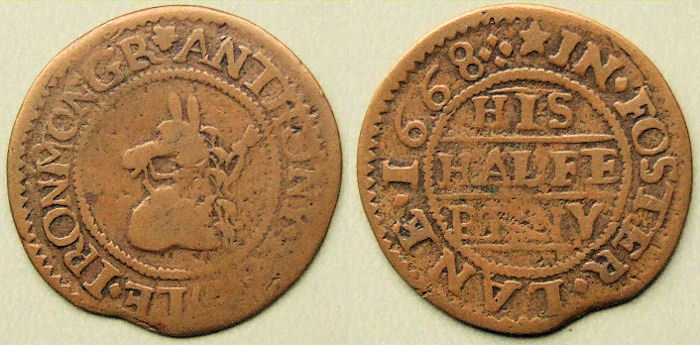
A half penny of Anthony Poole of Foster Lane, London

A half penny of Anthony Poole of Foster Lane, London

The above copper half penny measures 20.1 mm and weighs 1.86 grams. It was issued in the name of Anthony Poole, an ironmonger, who by the emblem on his token, appears to have traded under the sign of the Nag’s Head in Foster Lane. Foster Lane ran north off Cheap Side through the Aldersgate Ward of the city and into Farringdon Ward Within. This lane was traditionally the home of the goldsmith trade in London.

Obverse: (rosette) ANTHONY. POOLE. IRONMONGR around inner circle; a nag’s head within. Behind the Nag’s head the bridle appears to be held in a gloved hand.
Reverse: (mullet) IN.FOSTER.LANE.1668 (four pellets arranged in a diamond pattern) around inner circle; HIS / HALFE / PENY in four parallel lines within central field.

It is likely that Anthony Poole traded from a plot and under a trade sign that had previously been used by Samuel Dawson prior to the destruction of Foster Lane by the Great Fire of London. Samuel Dawson issued his own half penny trade tokens under the sign of the Nag’s Head in Foster Lane in 1666.

Anthony Poole was born in 1643 and died in 1679. He was buried in the churchyard or possibly the ruins of St Leonard’s in Foster Lane. St. Leonard’s Church was destroyed in the Great Fire and never re-built. Its ruins were later used as an extension of the churchyard for burials.

St. Leonard's Church, Foster Lane before the Great Fire of 1666

St. Leonard’s Church, Foster Lane before the Great Fire of 1666

I have been unable to find any further contemporary references to Anthony Poole other than in a printed transcription of the records of Worshipful Company of Clockmakers of the City of London (1) to which guild Anthony Poole was presumably a member. In an entry for 21st February 1671/2 we find Anthony being reprimanded for having “faulty goods”, in the form of folding brass tipped wooden rules, for sale in his shop in Foster Lane.

“At a search made the 21st day of February 1671, upon and for the concerns onely of the Mathematicall instrument Makers:
Present;
Nicholas Coxeter – Master
Samuell Horne & Jeffery Bayley – Wardens
John Nicasius, John Browne, Walter Hayes, Richard Ames – Assistants

There was seized in Shopps, within the limitts of the search of the Company, of severall Tradesmen who buy and sell and severall persons who make Mathematical measures and instruments, the workes and measures hereafter particularly expressed for that they are (as the said Walter Hayes, and John Browne, who are Mathematicall Instrument Makers and carried with them the company’s standards sealed in his Majesties Exchequer to trye and prove the same, doe finde and affirme them) not agreeable to the said standards and the rules and proportions of art, but are faulty and therefore not fitt to be put to sale (vizt.)

…Of Mr. Anthony Poole, Ironmonger in Foster Lane, seized two plaine joynted two foot Rules and five plaine two foot Rules foure of them being tipped with Brasse and one untipped.

…And upon the same day the said Mr. Anthony Poole appeared at the Court then holden and being fully satisfied upon tryall and proofe by the standards that the measures which were seized from him were faulty, one of them the most faulty was then broken by him and the rest were delivered back to him upon his promise not to put them to sale till made perfect.”

References:

1) Atkins, S.E. & Overall, W.H. Some Account of the Worshipful Company of clockmakers of the City of London (London. 1881).

2 Comments

Filed under Tokens from within the City Walls

The Trumpet in King Street, Westminster

A farthing of The Trumpet Tavern, King Street, Westminster

A farthing of The Trumpet Tavern, King Street, Westminster

The above brass farthing token measures 15.8 mm and weighs 0.71 grams. It was issued in the name of The Trumpet Tavern which was once located in King Street in St. Margaret’s Parish,Westminster. The design of the token may be formally described as follows;

Obverse: (star) THE.TRVMPET.IN.KINGS, around twisted wire inner circle, trumpet within.
Reverse: (star) STREETE.WESTMINSTER , around twisted wire inner circle, .C. over T (rosette) I within.

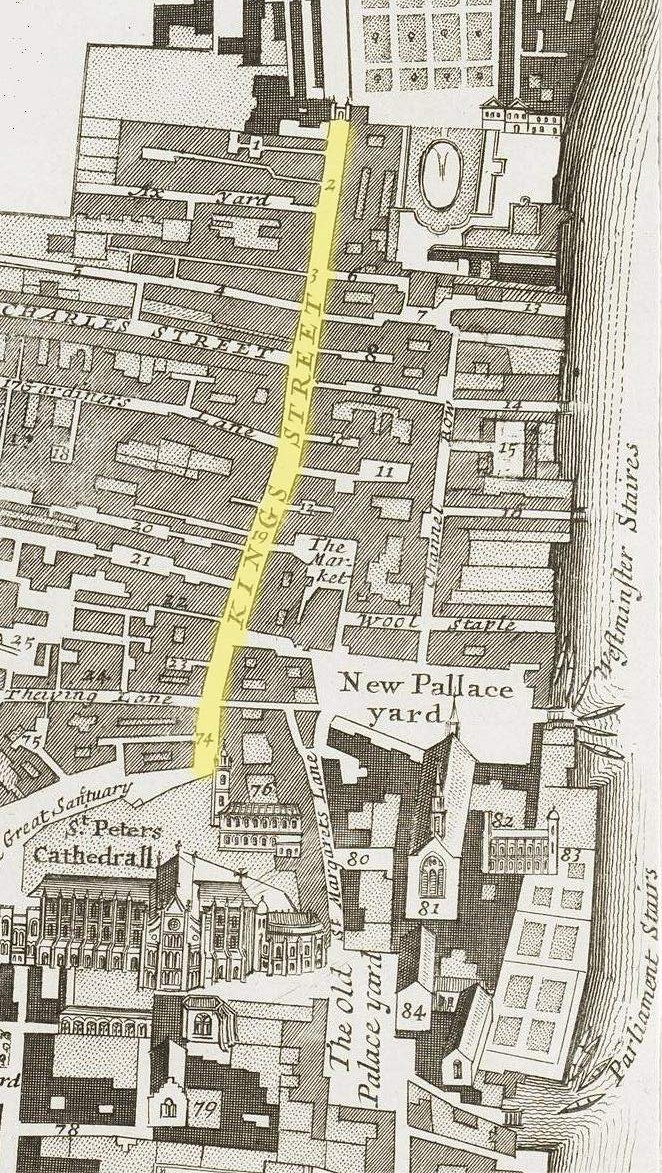
King Street, Westminster (c.1720)

King Street, Westminster (c.1720)

The initials of the couple that ran The Trumpet at the time the token was issued, a Mr. “T.C” and his wife Mrs.” J/I. C” have not as yet been positively identified by researchers. There are four individuals living in King Street at the time of the 1664 Hearth Tax who had initials that make them possible contenders;

King Street (North from the New Palace to the Sanctuary Gate):

1) Thomas Collins – 5 hearths recorded

King Street (North End):

2) Jane Charlton – 5 hearths recorded
3) Thomas Crispe – 6 hearths recorded
4) Captain Cooke – 6 hearths recorded

However, there are strong arguments that this token cannot be identified with any of the above. Firstly, in his diary entry for Saturday 9th January 1663/64 Pepys refers to the Trumpet as Mrs. Hare’s. Not a Mrs. C’s. Furthermore the style of this farthing token would identify it (and hence the tenancy of its issuers) with an earlier date than 1664. It is perfectly conceivable that by the time of the 1664 Hearth Tax our Mr. and Mrs. “C” may well have moved on.

The Trumpet is one of five taverns in King Street, Westminster, that was mentioned by Samuel Pepys in his diaries. The other mentioned were; The Bell, The Dog, The Sun and The Angel. The Angel and The Trumpet are the least two mentioned of this group and were obviously not his favourite drinking establishments in the street.
The Trumpet is mentioned in five separate entries in Pepys’ diary as listed chronologically below. On the last occasion (in January 1664/5) it appears that he was using it as a rendezvous for one of his many illicit extra marital liaisons, safe in the knowledge that none of his acquaintances would be there.

Saturday 4th August 1660

…I went and bespoke some linen of Betty Lane in the Hall, and after that to the Trumpet, where I sat and talked with her, &c. At night, it being very rainy, and it thundering and lightning exceedingly, I took coach at the Trumpet door, taking Monsieur L’Impertinent along with me as far as the Savoy, where he said he went to lie with Cary Dillon, and is still upon the mind of going (he and his whole family) to Ireland.”

Saturday 9th January 1663/64

“After dinner by coach I carried my wife and Jane to Westminster, leaving her at Mr. Hunt’s, and I to Westminster Hall, and there visited Mrs. Lane, and by appointment went out and met her at the Trumpet, Mrs. Hare’s, but the room being damp we went to the Bell tavern, and there I had her company, but could not do as I used to do (yet nothing but what was honest) … So I to talk about her having Hawley, she told me flatly no, she could not love him.”

Monday 15th August 1664

“To the Coffee-house I, and so to the Change a little, and then home to dinner with Creed, whom I met at the Coffee-house, and after dinner by coach set him down at the Temple, and I and my wife to Mr. Blagrave’s. They being none of them at home; I to the Hall, leaving her there, and thence to the Trumpett, whither came Mrs. Lane, and there begins a sad story how her husband, as I feared, proves not worth a farthing, and that she is with child and undone, if I do not get him a place. I had my pleasure here of her, and she, like an impudent jade, depends upon my kindness to her husband, but I will have no more to do with her, let her brew as she has baked, seeing she would not take my counsel about Hawly. After drinking we parted……”

Friday 9th December 1664

“At noon home to dinner, Mr. Hunt and his wife with us, and very pleasant. Then in the afternoon I carried them home by coach, and I to Westminster Hall, and thence to Gervas’s, and there find I cannot prevail with Jane to go forth with me, but though I took a good occasion of going to the Trumpet she declined coming, which vexed me. “Je avait grande envie envers elle, avec vrai amour et passion”. (Trans: I longed for her with true love and passion). Thence home and to my office till one in the morning……”

Sunday 22nd January 1664/65

“After dinner walked to Westminster, and after being at the Abbey and heard a good anthem well sung there, I as I had appointed to the Trumpett, there expecting when Jane Welsh should come, but anon comes a maid of the house to tell me that her mistress and master would not let her go forth, not knowing of my being here, but to keep her from her sweetheart. So being defeated, away by coach home, and there spent the evening prettily in discourse with my wife and Mercer, and so to supper, prayers, and to bed.”

Leave a comment

Filed under Tokens from Pepys' London, Tokens from West of the City Walls

Bartholomew Fish of Queenhithe

A half penny token of Bartholomew Fish of Queenhithe, London

A half penny token of Bartholomew Fish of Queenhithe, London

The above half penny copper token measures 20.4 mm and weighs 2.21 grams. It was issued in the name of Bartholomew Fish of Queenhithe in 1667. The design of the token may be formally described as follows;

Obverse: (rosette) BARTHOLLOMEW.FISH , around twisted wire inner circle, three fishes within.
Reverse: (rosette) AT.QVEENEHITHE.1667, around twisted wire inner circle, HIS / HALFE / PENY , in three lines. Below a rosette flanked by two sets of three dots each arranged in a triangle.

Bartholomew Fish is recorded as a fletcher living in St. Michael’s Parish, Queenhithe. This was a dock on the north bank of the River Thames. It was bordered by Thames Street to the north, Brookes Hill Wharf to the west and Towns End Lane to the east.

Queenhithe from John Ogilby & William Morgan’s 1676 Map of the City of London

Queenhithe from John Ogilby & William Morgan’s 1676 Map of the City of London

In the 1662 Hearth tax return Bartholomew is recorded as occupying a property in the third precinct of St. Michael’s, Queenhithe Ward, having five hearths.

This area the city was totally consumed by the Great Fire of 1666. In “The survey of Building Sites in the City of London after the Great Fire of 1666” an entry is recorded on the 21st June 1671 for the receipt of money for staking out the foundations of a property in Queenhithe belonging to one Bartholomew Fish.

Bartholomew Fish was married to Martha Fish and between them they are recorded as having four children – Elizabeth, Martha, Mary and Rebecca.

A copy of Bartholomew’s will, dated 1676, is held in the National Achieves (Kew) in which he leaves his estate to his wife and four daughters. By this date two of his daughters had married, Martha to Nathaniel Mason and Elizabeth to William Noble. His will was witnessed by Edward Reeve and Jeremy Holmes.

At further farthing token is recorded bearing the obverse device of three fish and carrying the reverse issuers’ initials of B. M. F. The obverse and reverse legends this token attest to the issuers trading at the sign of the Nobel Garter in Queenhithe. This token was almost certainly issued by Bartholomew and Martha Fish.

The obverse device of three fish on this token is probably a play on words given Bartholomew’s surname.

Leave a comment

Filed under Tokens from within the City Walls