Monthly Archives: June 2013

The King’s Head at Chancery Lane End

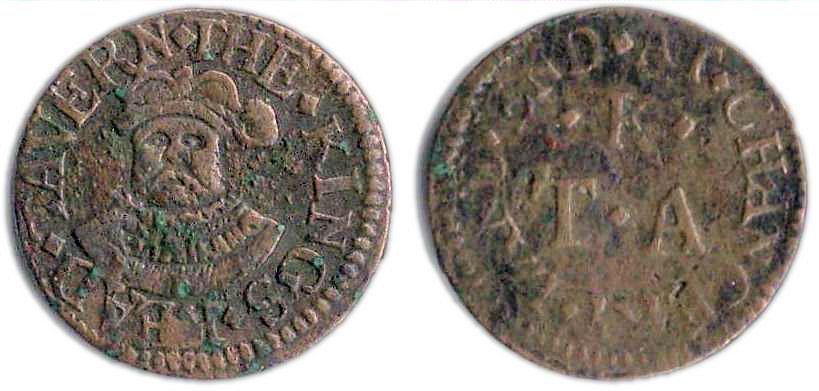
A farthing token issued in the name of the King's Head Tavern on the corner of Chancery Lane and Fleet Street, London

A farthing token issued in the name of the King’s Head Tavern on the corner of Chancery Lane and Fleet Street, London

The above copper farthing token measures 16.1 mm and weighs 1.63 grams. It was issued in the name of The King’s Head Tavern which was located on the corner of Chancery Lane and Fleet Street in the City of London.

The design of the token may be formally described as follows;

Obverse: .THE.KINGS.HEAD.TAVERNE , around the central depiction of a the facing head and shoulders of King Henry VIII.
Reverse: .AT.CHANCERY.LANE.END. , around a triad of initials comprising T | .K. | .A

The King’s Head is first recorded in 1472. It was one of the forty permitted taverns (as opposed to inns or the later introduced “ordinaries”) fully licensed to operate within London under an Act passed in 1553. From his diary entries (1663-69) we know that Samuel Pepys was familiar with at least 10 of these earlier listed taverns including the King’s Head. Despite the fact that his travels to and from the Navy Office and Whitehall would have taken him past the King’s Head on a regular basis Pepys only records two visits to the tavern during the six years he was writing his diary.  These are reproduced (in part) below.  The reference may be to a separate establishment of the same name in a different part of the city as Pepys refers to the establishment as an “ordinary” as opposed to a tavern. There were discreet differences between taverns, inns and ordinaries and it is doubtful that Pepys would have confused the two definitions. The King’s Head at the southern end of Chancery Lane was a well-known city tavern and land mark.

21th June 1665

“Up and to White Hall with Sir J. Minnes, and to the Committee of Tangier, where my Lord Treasurer was, the first and only time he ever was there, and did promise us £15,000. for Tangier and no more, which will be short. But if I can pay Mr. Andrews all his money I care for no more, and the bills of Exchange. Thence with Mr. Povy and Creed below to a new chamber of Mr. Povy’s, very pretty, and there discourse about his business, not to his content, but with the most advantage I could to him, and Creed also did the like. Thence with Creed to the King’s Head, and there dined with him at the ordinary, and good sport with one Mr. Nicholls, a prating coxcombe, that would be thought a poet, but would not be got to repeat any of his verses. Thence I home, and there find my wife’s brother and his wife, a pretty little modest woman, where they dined with my wife.”

2nd April 1668

“Thence with Lord Brouncker to the Royall Society, where they were just done; but there I was forced to subscribe to the building of a College, and did give £40.; and several others did subscribe, some greater and some less sums; but several I saw hang off: and I doubt it will spoil the Society, for it breeds faction and ill-will, and becomes burdensome to some that cannot, or would not, do it. Here, to my great content, I did try the use of the Otacousticon, —[Ear trumpet.]— which was only a great glass bottle broke at the bottom, putting the neck to my eare, and there I did plainly hear the dashing of the oares of the boats in the Thames to Arundell gallery window, which, without it, I could not in the least do, and may, I believe, be improved to a great height, which I am mighty glad of. Thence with Lord Brouncker and several of them to the King’s Head Taverne by Chancery Lane, and there did drink and eat and talk, and, above the rest, I did hear of Mr. Hooke and my Lord an account of the reason of concords and discords in musique, which they say is from the equality of vibrations; but I am not satisfied in it, but will at my leisure think of it more, and see how far that do go to explain it. So late at night home with Mr. Colwell, and parted, and I to the office, and then to Sir W. Pen to confer with him, and Sir R. Ford and Young, about our St. John Baptist prize, and so home, without more supper to bed, my family being now little by the departure of my wife and two maids.”
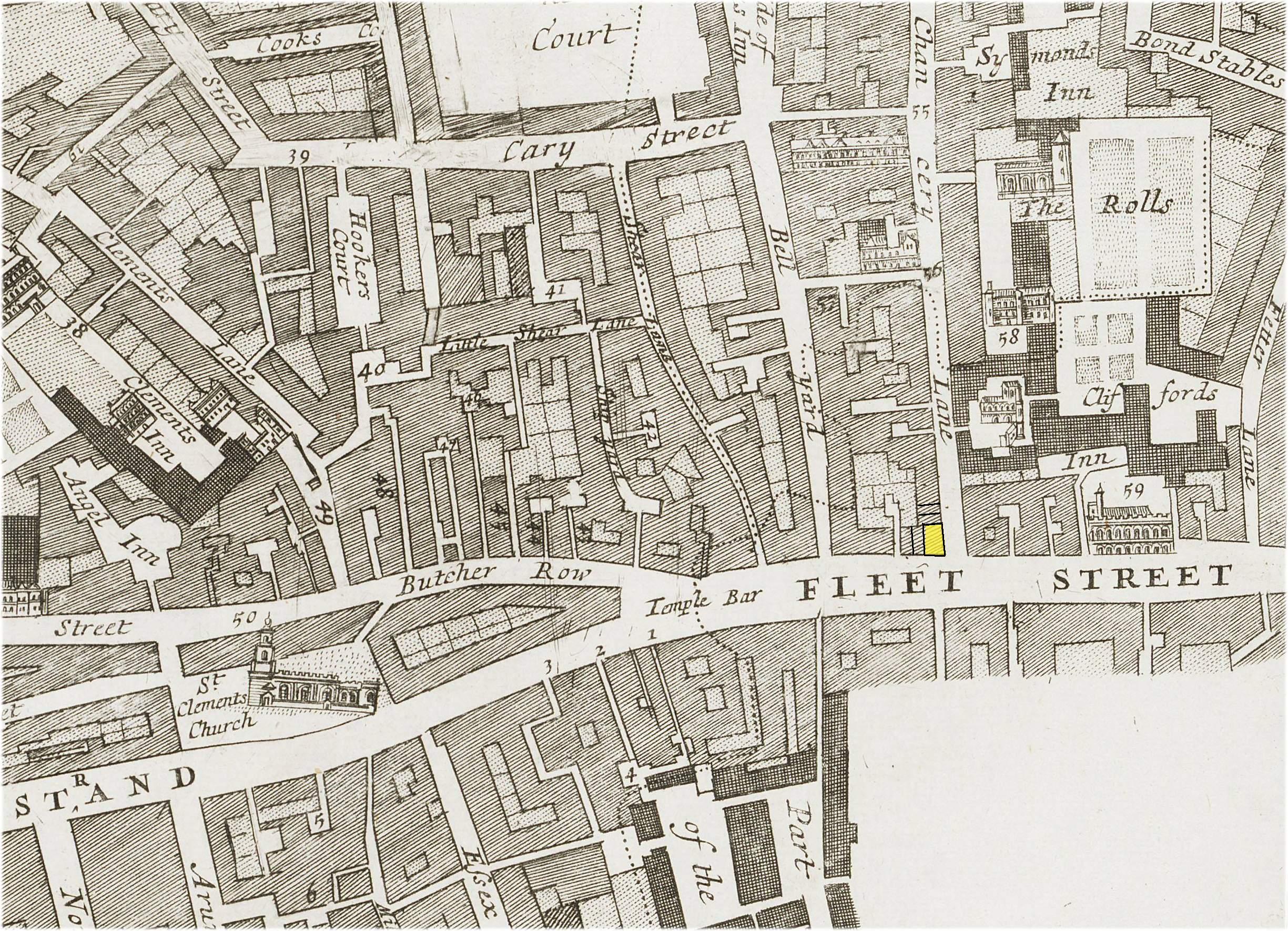
The location of the King's Head Tavern on the corner of Chancery Lane and Fleet Street, London (c.1720)

The location of the King’s Head Tavern on the corner of Chancery Lane and Fleet Street, London (c.1720)

Three separate sets of tokens (two farthings and a half penny) were issued in the name of the King’s Head tavern by three successive landlords. Each of these sets of tokens carries the initials of their respective issuers. While none of the tokens  are dated it is possible to arrange them in a chronological issuing sequence as their respective issuers have been identified and their tenancies approximately date as follows;

T.K. & A.K. – Thomas Kent and his wife (Anne?) who ran the tavern from 1630 to 1660

L.W. & H.M. – The partnership of Lewis Wilson and Henry Morris who ran the tavern between 1660 to c.1662. After which Henry Morris appears to have left the partnership.

W.M. & K.M. – William Mart and his wife (Katherine?) who ran the tavern between 1666 to 1682. Prior to this the couple had run the Queen’s Head in Fleet Street where they also issued trade tokens.

The farthing token illustrated above is one of those issued during the tenancy of Thomas Kent and his wife. This is indicated by the triad of issuers’ initials displayed on its reverse side. Thomas Kent’s name first appears in the St. Dunstan’s list of vintners in 1630 and remains on it until 1660. In the Lambeth Tithes list of 1638 his rent is accessed as £70. A poll list of 1660 includes a reference “Mr. Thomas Kent, vintner, has been warden“. In a further parish list of the same year Kent’s name is replaced by those of Henry Morris and Lewis Wilson (1).

According to one reference only the first and second floors of the ancient four-story building on the corner of Fleet Street and Chancery Lane were devoted to housing the King’s Head tavern. Amongst other rooms the tavern possessed a dedicated dining room plus a music room (2). The Hearth Tax return for Fleet Street in 1666 indicates that during the tenancy of William Mart the King’s Head possessed 20 hearths.. The building’s ground floor housed shops. One was a grocery which was run by the father of the famous 17th century poet Abraham Cowley another a book shop run by Thomas Maxey from where he printed and sold the first edition of Izaak Walton’s “Complete Angler”. Luckily for all the tradesmen that operated from this ancient building the Great Fire of London (1666) stopped just short of its location on Fleet Street.

During Samuel Pepys’ time the King’s Head tavern was known as a “Protestant House”. Between c.1675 and 1683 it was the meeting place of the Green Ribbon Club (3) . This notorious group comprised lawyers, city politicians, and MPs alarmed by what they perceived to be a drift towards “popery” and arbitrary government under King Charles II together with the prospect of Charles’ brother, the Duke of York (later King James II), inheriting the throne.  The club took its name from the green ribbons which its members wore in their hats and which subsequently proved to be a useful means of recognition in street brawls. The choice of this emblematic badge was derived from the similar ribbons attached to the clothes worn by the Levellers. The Levellers were a pre-eminent political group that rose to prominence during the English Civil Wars and which had a significant following with Oliver Cromwell’s New Model Army as well as within the general populace of the city of London. Many of the club’s members had extreme protestant views and were supporters of Titus Oates and his anti-Catholic rantings. They were also associated with the Rye House Plot and the Duke of Monmouth’s rebellion. According to the playwright John Dryden, drinking was the chief attraction of the club and the members talked and organized sedition over their cups.

Prior to 1679 the club’s had been known as the King’s Head Club, after the tavern where they met. The tavern’s trade sign depicted of the head of King Henry VIII (as per that used on its tokens). As Henry was Britain’s first protestant ruler it made this already well-known Fleet Street tavern the ideal meeting place and emblematic home of the club.

Included amongst the club’s most notable members were the Duke of Monmouth, the Earl of Halifax, the 3rd Earl of Shaftesbury. The latter famously harangued Samuel Pepys, during his early parliamentary career, accusing him of being a Roman-catholic in an attempt to undermine him.

In 1680 and 1681 the club organised pope-burning processions on the anniversary dates of Queen Elizabeth I’s accession to the throne. These ended by the lighting of huge bonfires in front of the King’s Head tavern and proved an effective means of inflaming the religious passions of the populace.
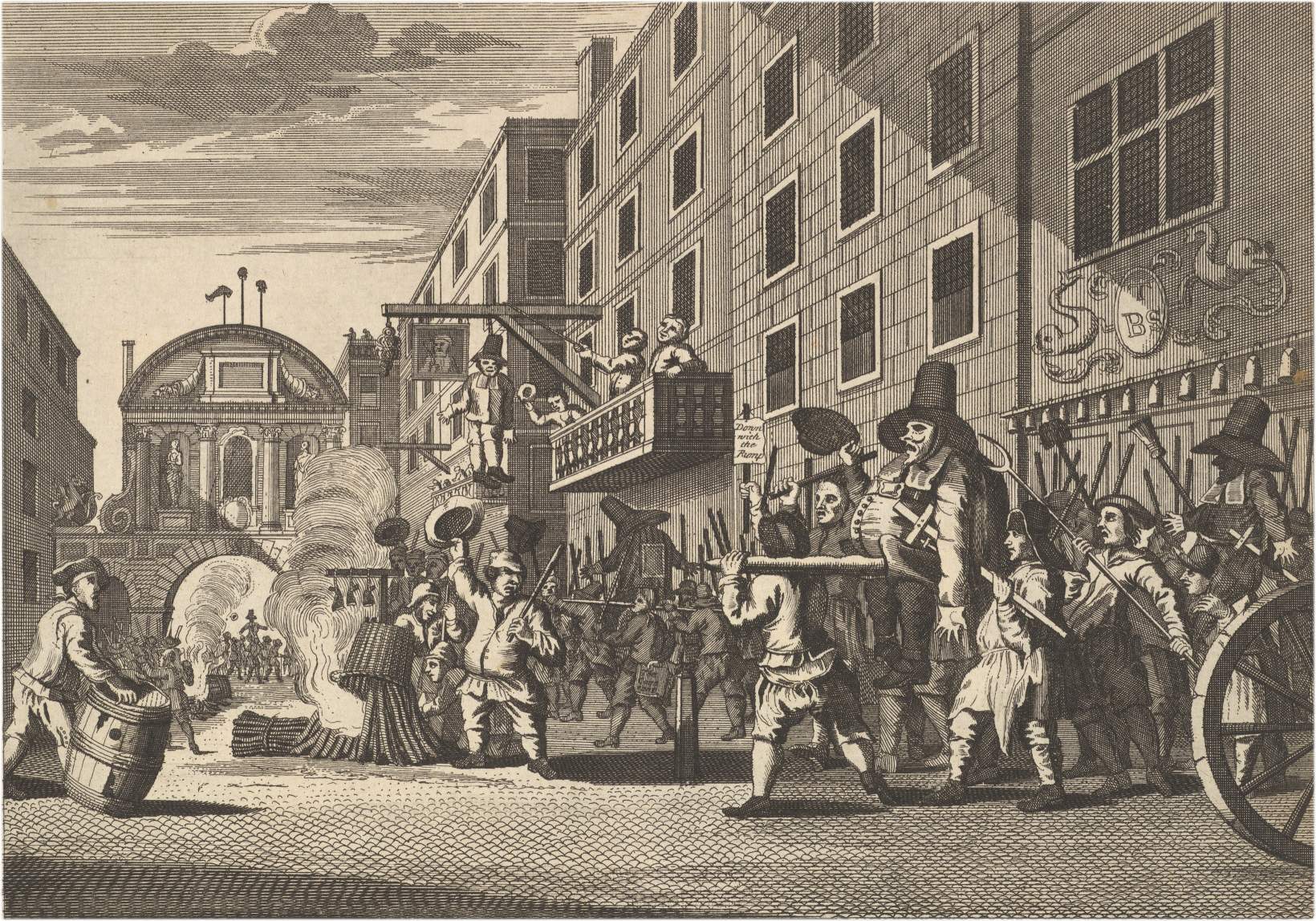
William Hogarth's depiction of a street celebration in April 1653 outside the King's Head tavern in Fleet Street applauding the dissolution of the Rump Parliment by Oliver Cromwell.

William Hogarth’s depiction of a street celebration in April 1653 outside the King’s Head tavern in Fleet Street applauding the dissolution of the Rump Parliament by Oliver Cromwell.

A near contemporary image of Fleet Street looking west towards Temple Bar Gate can be found in an engraving by William Hogarth. The vantage point for this view is at, or very close to, the street frontage of the King’s Head tavern. This image was commissioned as part of a set of prints to illustrate an issue of Samuel Butlers poem “Hudibras”. The content of the print is that of a street protest against the “Rump Parliament” which was dissolved by Oliver Cromwell on 20th April 1653. Its depicts members of the public roasting rump steaks on an open bonfire together with full size effigies of members of parliament being hung from shop front signs. This possibly fictitious scene will know doubt have resembled the actual events which took place outside the King’s Head tavern in 1680 and 1681 when the Green Ribbon Club’s pope-burning processions reached their climactic finale.

In the late 17th century Robert Hooke and other fellows of the Royal Society are noted by one source (4) to have regularly met at the King’s Head Tavern. As President of the society from 1684 to 1686 Samuel Pepys was probably amongst those notable members who attended such meetings. No doubt the meetings of the Royal Society members were less rowdy and quieter affairs than the earlier meetings of the Green Ribbon Club.

A late 18th century painting of the building which once housed the King's Head Tavern

A late 18th century painting of the building which once housed the King’s Head Tavern (by William Alexander 1767-1816).

 A late 18th century image of the building is preserved in a picture by the artist William Alexander. The tavern’s distinctive trade sign, which depicted the head of King Henry VIII, is no-longer visible in this picture which confirms its was painted after the tavern had ceased to operate. The tavern was demolished in 1799 af the widening of Chancery Lane (2). Today the site of its original location is occupied by George Attenborough & Son (jewellers at 193 Fleet Street).

References:

1) Berry, G. – Tavern Tokens of Pepy’s London. (London, 1978).

2) Wheatley, H.B – London: Past and Present: Its History, Associations and Traditions. (London, 1891).

3) Shelley, H.C. – Inns and Taverns of Old London. (London, 1909).

4) Jungnickel, C. & MacCormmach, R. – Cavendish. (Philadelphia, 1996).

Leave a comment

Filed under Tokens from Pepys' London, Tokens from within the City Walls

William Minshew of Rosemary Lane, Whitechapel

A farthing token issued in the name of William Minshew of Rosemary Lane in Whitechapel

A farthing token issued in the name of William Minshew of Rosemary Lane in Whitechapel

The above copper farthing token measures 16.3 mm and weighs 1.12 grams. It was issued in the name of William Minshew of Rosemary Lane in eastern London in 1659.

The design of the token may be formally described as follows;

Obverse: (star) WILL.MINSHEW.IN, around the depiction of a swing plough facing left.

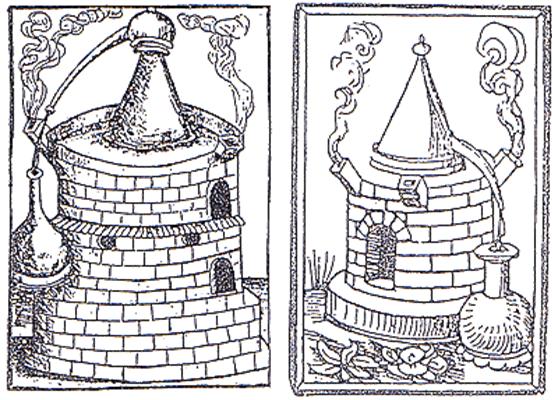
Reverse: (star) ROSEMARY.LANE 59, around the depiction of a still mounted on a masonry hearth with flames issuing from the top right side and distillate being collected in a receiving vessel located on its left side.

The “59” in the token’s reverse legend is an abbreviated issue date, i.e. 1659.

Near contemporary depictions of similar stone hearth mounted stills to the one shown on William Minshew's farthing Token (c.16 to 17th century woodcuts)

Near contemporary depictions of similar stone hearth mounted stills to the one shown on William Minshew’s farthing Token (c.16 to 17th century woodcuts)

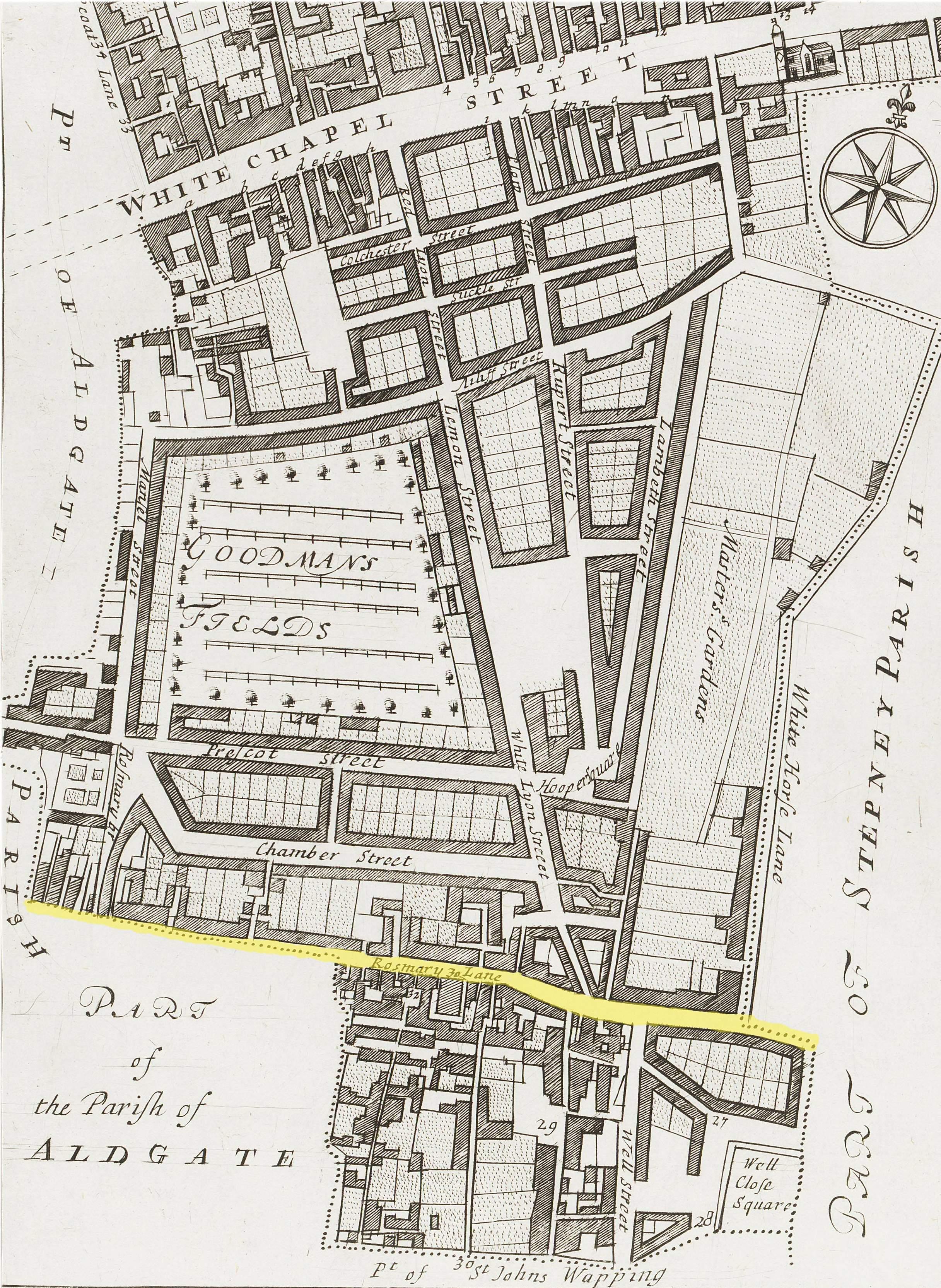
Rosemary Lane (originally Hog Lane, or Hoggestrete) was the continuation of what is now Cable Street, running from the junction with Dock Street and Leman Street towards the Tower of London. Rosemary Lane was renamed Royal Mint Street in 1850. It crossed the parishes of Aldgate (in the west) and Whitechapel (in the east).

The section of Rosemary Lane which passes through the Parish of Whitechapel (c.1720)

The section of Rosemary Lane which passes through the Parish of Whitechapel with St. Mary’s Church in the top right on Whitechapel Street (c.1720)

I have been unable to find any conclusive evidence of where and when William was born. However, he could well be one of the following individuals who are recorded in their respective parish baptism records;

1)      William Minshawe – Baptised in the parish church of Garlickhithe on 1st September 1630. The son of Randall and Ursley Minshawe

2)      William Mynshawe – Christened in the parish church of St. Andrew by the Wardrobe on 26th July 1630. The son of Edward Mynshawe

3)      William John Minshaw – Christened in the parish church of St. Benet Paul’s Wharf on 18th May 1637.

By 1659, the date of issue on his tokens, we know that William Minshew was resident in Rosemary Lane. In isolation the presence of only his initials on the reverse side of his tokens suggests that at the time of their issue William was unmarried. If married it would was usual for tradesmen to apply a triad of initials to the reverse side of their tokens. These typically comprised the side by side initials of the couple’s two Christian names below that of their common surname.  However, a search of local parish registers indicates a William and Alice Minshew living in the parish of St. Mary’s, Whitechapel from at least 1654. The parish baptism records the couple having the following children;

  • Sarah Minshew; baptised on 11th January 1654/5
  • John Minshew; baptised on 13th October 1658
  • Mary Minshew; baptised on 16th June 1661
  • William Minshew; baptised 7th June 1663

Further analysis of the parish registers of St. Mary’s, Whitechapel indicates the following relevant entries for the family;

  • William Minshew; buried on 9th August 1664
  • Alice Minshew; buried on 20th January 1688/9 (1)

It is not clear if the burial of William Minshew recorded above is that of the token issuer or his infant son.

A further search of Hearth Tax returns for 1666 from the districts of Whitechapel and Aldgate has failed to return any entries for either a William or Alice Minshew.

The association of the Minshew family with St. Mary’s, Whitechapel potentially narrows down the stretch of Rosemary Lane on which the family may have lived (i.e. the eastern section which lay within Whitechapel).

A depiction of a Rag Fair in Rosemary Lane, East London (late 18th century print by Thomas Rowlandson)

A depiction of a Rag Fair in Rosemary Lane, East London (late 18th century print by Thomas Rowlandson)

From the mid-17th century Rosemary Lane gained strong associations with the second-hand rag/cloth trade. However, like in other areas of London the occupations of the tradesmen and women who lived and worked in the lane were far more diverse. At least 29 tradesmen living on Rosemary Lane during the mid-17th century are known to have issued tokens. Their trades are varied and include an ironmonger, a cheesemonger, a pastry cook, a fruitier, a cable maker, a blacksmith, a fishmonger, a tobacconist, a brewer plus several victuallers. While not a fellow token issuer there was at least one other “tradesman” living on Rosemary Lane around the same time as William Minshew who is worth noting. This individual was a Hangman by the name of Richard Brandon, a trade which he had inherited from his father, Gregory Brandon, who had been an Axeman or executioner.  Richard died in 1649. While his burial register entry in the parish registers of St. Mary’s Whitechapel is in itself unremarkable, “1649. June 2. Richard Brandon, a man out of Rosemary Lane” the note next to it is not, “This R. Brandon is supposed to have cut off the head of Charles I”. The historical content of this note is supported by several contemporary anecdotes.

Based on the information contained on his token William Mishew’s occupation is unclear. The token’s obverse depicts a plough while its reverse depicts a still. In London the sign of the plough was adopted from the 16th century onwards by several taverns but was by no means exclusive to that trade. The image of a still suggests a possible inference that William may have been a distiller, although this again is by no means a certainty. The sign of the still was used by some taverns and possibly some members of the Apothecaries’ Society who, for a period in the 17th century, viewed the Worshipful Company of Distillers as partial rivals to elements of their trade.

One interpretation of the emblems on this particular token is that William Minshew was a distiller operating from premises in or near the building occupied by a tavern which went by the name or sign of the Plough. A review of the 30 token types known to have been issued from traders in Rosemary Lane indicates a degree of commonality with respect to the emblems used on their tokens. These include;

1)      Sam Crisp, cheesemonger at the sign of the still.

2)      Mr.  C.W. and Mrs.  F.W. at the sign of the plough (possibly keepers of a tavern by the name of the Plough).

3)      P. H. Doe on Armetage Bridge (2). This token bears the emblems of a wheat sheaf on its obverse and a plough on its reverse (possibly a trader in grain or cereals operating at or close to a tavern by the name of the Plough).

Notes:

1)      Rather confusingly there is a second burial register entry for an Alice Minshew the day before that listed above (i.e. 19th January 1668/9) in the adjoining parish registers of St. Botolph’s, Aldgate.

2) As yet the author has not been able to identify this exact location on Rosemary Lane.

1 Comment

Filed under Tokens from East of the City Walls

The Fleece in Covent Garden

A farthing token issued in the name of the Fleece Tavern in Covent Garden, Westminster

A farthing token issued in the name of the Fleece Tavern in Covent Garden, Westminster

The above copper farthing token measures 15.6 mm and weighs 0.94 grams. It was issued in the name of The Fleece Tavern in Bridges Street. This now lost street lay off the eastern side of Covent Garden in Westminster.

The design of the token may be formally described as follows;

Obverse: (mullet) AT.THE.FLEECE.TAVERNE , around the central depiction of  a sheep’s body facing left and suspended in a harness around its middle.
Reverse: (mullet) .IN.COVEN.GARDEN. , around twisted wire inner circle, letters W.C within.

This is one of two undated tokens, a farthing and a half penny, of similar design which were issued from the Fleece Tavern in Covent Garden and which bear the issuer’s initials W.C. The slightly larger half penny tokens also carry the issuers name in full, William Clifton, so there is no doubt who was responsible for their issue.

Although not a common inn sign today the emblem of the Fleece or Golden Fleece was not uncommon in the 17th century. As well as being a common inn sign it was also adopted by tradesmen working in branches of the wool trade.

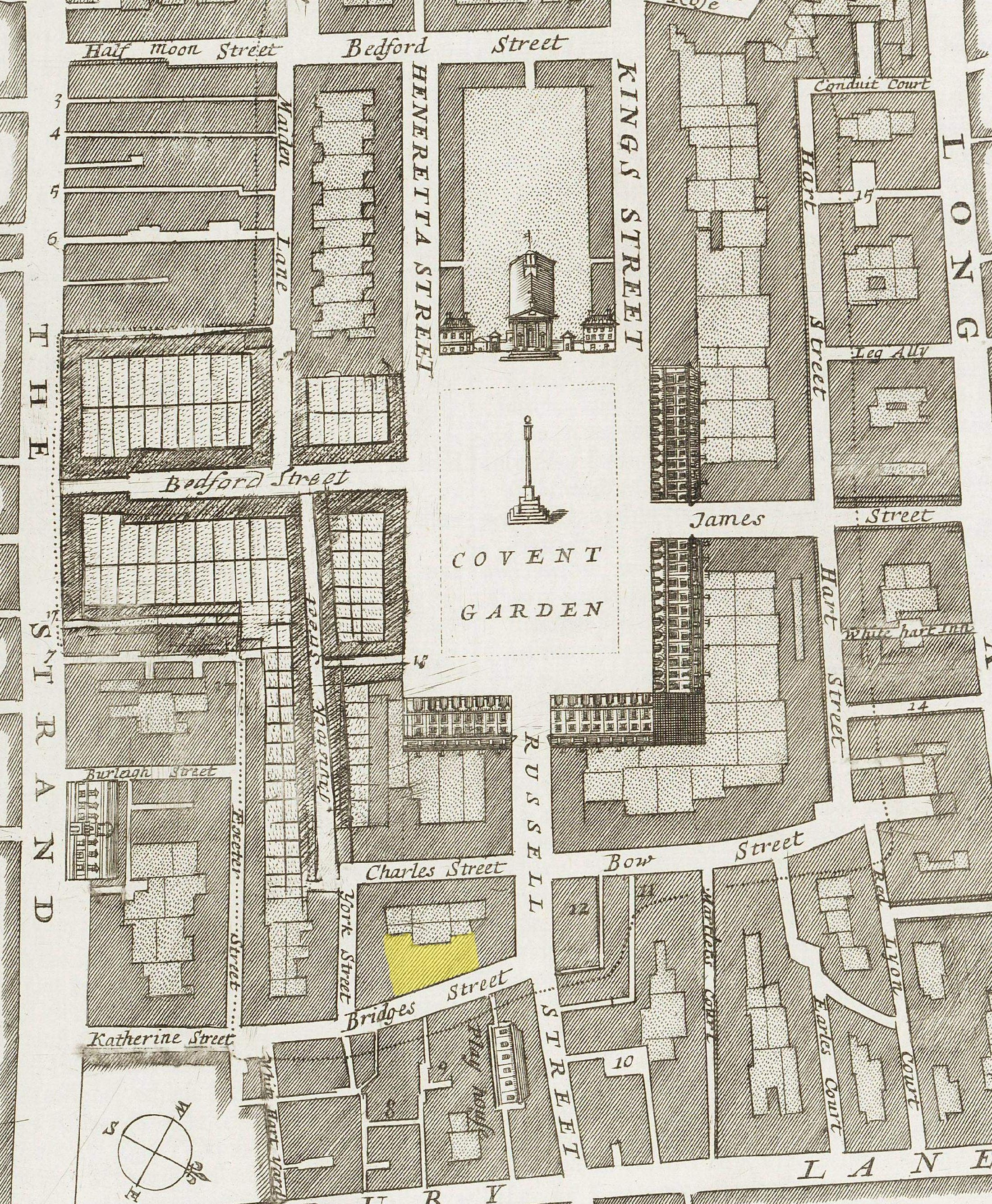
A plan of Covernt Garden (c.1720) showing the approxiamest location of the Fleece Tavern

A plan of Covent Garden (c.1720) showing the approximate location of the Fleece Tavern

Immediately after the Restoration the taverns of Covent Garden, notably the Rose and the Fleece taverns on Bridges Street, gained an unsavoury reputation as places of licentiousness and violence which included several mur­derous assaults that took place on their premises.

The establishment of the Fleece tavern dates to the building of Bridges Street in 1632. According to one early token researcher, Henry Beaufoy,(1)  an entry in the 1651 rate book for the Covent Garden area notes the Fleece tavern as being located six houses down from the corner of Bridges Street and Russell Street, an area later taken up by the Drury Lane Theatre. The same rate book also confirms that William Clifton was then the tavern’s landlord. The location of the Fleece on the south-west side of Bridges Street is confirmed by later authors. However, John Aubrey (2) writing in 1696 claims it to have been in York Street. This may allude to the tavern having a back entrance, no doubt a very convenient resource for such a dubious establishment.

Prior to 1633/4 William Clifton was landlord of the Goat tavern in nearby Russell Street before moving to the Fleece where he took over from the previous landlord, Thomas Gough (3) . After arriving in his new premises in Bridges Street he soon appeared to have issues with William and Mary Long, who ran the neighbouring Rose tavern which was located on the corner of Bridges Street and Russell Street. The Fleece seems to have been a more prosperous establishment than its neighbour. According to one previous study (1)  in the local rate book of 1657 William Clifton is assessed at 26/- whilst William Long at the Rose was assessed at only half that amount. This relative prosperity bias may be down to the comparative size of the two establishments. In the 1666 Hearth Tax return from the Covent Garden district the entry for William Clifton is for a sizeable premises with 24 hearths while that for Mary Long (at the Rose) is for on 14 hearths. Despite running a large tavern such as the Fleece it appears that William Clifton still found time to undertake additional responsibilities within his local parish (St. Paul’s, Covent Garden). In 1644 he is reported as being an overseer of the poor (4).

The churchwardens’ accounts for St. Paul, Covent Garden contain several references to the Fleece;

1657 – refer to a payment of 26/- “for mending the grate over the sewer by the Fleece Tavern”.

1658 – payment on 12th April to “Mr. Clifton £3-13-0 for wine for the last yeare”‘.

There is a further mention of William Clifton in an issue of the Kingdom‘s Intelligencer of December 1661. A public announcement refers to the loss of a looking-glass and some gilt leather hangings. Anyone who knew of their whereabouts and who reported the matter to “Mr. Clifton at the Fleece Tavern” was to be rewarded with 40 shillings.

In the original research undertaken into this token issuer by Henry Beaufoy he mentions that he was unable to discover Clifton’s name in the burial registers of St. Paul’s, Covent Garden although there were interments recorded for the following related or associated individuals;

12th November 1658 – Mr. Clifton’s man

21st March 1661 – Thomas, son of William Clifton

13th September 1672 – Amey Watts, Mr. Clifton’s servant

26th February 1675 – Widow ………… More, from the Fleece – The parish clerk had left a blank in the register and added a footnote that he did “not lerne her christian name” 

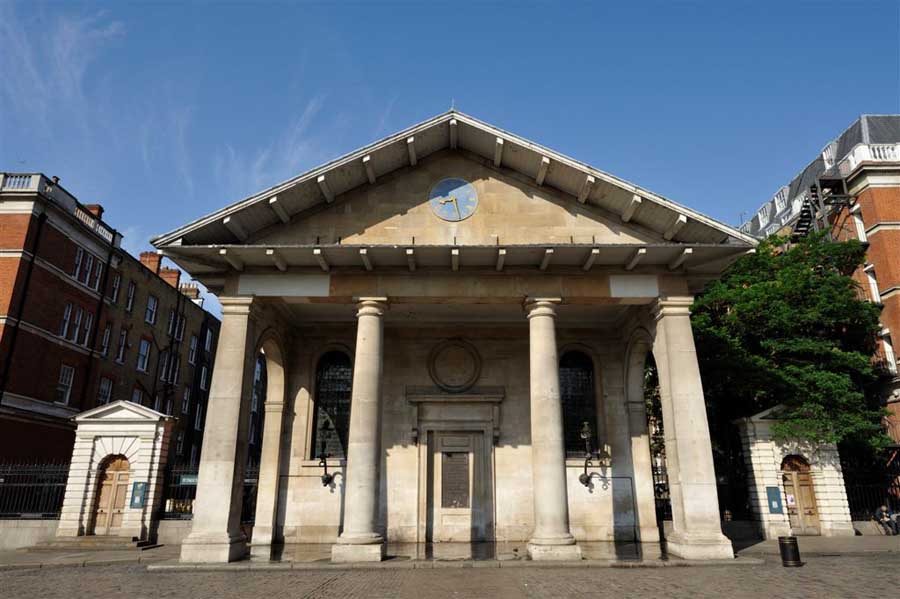
St. Paul's Church, Covent Garden - Much as it would have appeared when originally built in 1633

St. Paul’s Church, Covent Garden – Much as it would have appeared when originally built in 1633

Clifton was vintner at the Fleece from 1633/4 until at least 1672. According to one source William died in 1672 and his wife, Martha, continued as landlady. The current researcher has not been able to find any records of the marriage of William and Martha Clifton. The farthing and half penny tokens issued in the name of the Fleece only bear William’s initials, instead of the a triad of token issuer’s initials which are usually displayed if the primary issuer is a married man. On the basis that neither of the token types issued by William Clifton from the Fleece probably date to no later than c.1660 it would be reasonable to assume that William and Martha weren’t married until after this time.

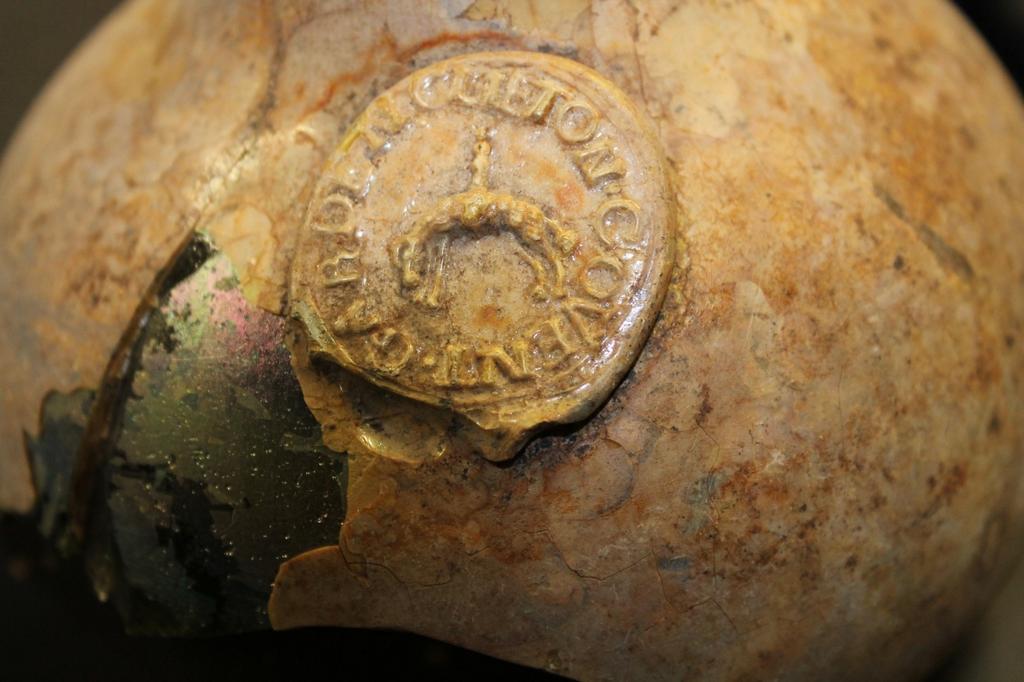
The seal of William Clifton of the Fleece tavern in Govent Garden. The bottle is of the shaft and globe variety (1650-80) and was found by MOLA (Museum of London Archaeology) on excavations on St. Helen’s Place, Bishopsgate in the City of London. Photograph by Nicholas Major and supplied by Nigel Jeffries (MOLA).

The seal of William Clifton of the Fleece tavern in Govent Garden. The bottle is of the shaft and globe variety (1650-80) and was found by MOLA (Museum of London Archaeology) during excavations on St. Helen’s Place, Bishopsgate in the City of London. Photograph by Nicholas Major and supplied by Nigel Jeffries (MOLA).

While it is not known when he died a foot note in a manuscript copy (held in the library of the Royal Society) of John Aubrey’s earlier sited reference to the Fleece tavern states “Clifton the master of the house, hanged himself having perjured himself”. This being the case it fully explains why no burial record can be found for William Clifton in the parish register for St. Paul’s Church in Covent Garden or for that matter any other parish burial records. As a suicide victim Clifton would have not been eligible for burial in consecrated ground and hence his death will have gone unrecorded in church records.

According to one source (3) the Fleece burnt down in 1688 and was rebuilt as a private house. This building was still standing in 1722 as an advertisement in the Daily Post for 22 January 1722 relates “To be let furnished or unfurnished a very good house in Bridge Street, two doors from the Play House, the corner of Vinegar Yard at the Green Raith which was formerly the Fleece Tavern“. The former location of the Fleece, like the Rose, must have been engulfed in the exten­sions to the Drury Lane Theatre in 1766.

Despite its reputation the Fleece Tavern was a popular haunt of Samuel Pepys . Between the period 1660 to 1669 he visited the tavern on at least 4 separate occasions which he records in his famous diaries. The associated entries are listed below chronologically.

1st December 1660

“I went to my Lord St.Albans lodgings, and found him in bed, talking to a priest (he looked like one) that leaned along over the side of the bed, and there I desired to know his mind about making the catch stay longer, which I got ready for him the other day.  He seems to be a fine civil gentleman.  To my Lord’s, and did give up my audit of his accounts, which I had been then two days about, and was well received by my Lord.  I dined with my Lord and Lady, and we had a venison pasty.  Mr. Shepley and I went into London, and calling upon Mr. Pinkney, the goldsmith, he took us to the tavern, and gave us a pint of wine, and there fell into our company old Mr. Flower and another gentleman; who tell us how a Scotch knight was killed basely the other day at the Fleece in Covent Garden, where there had been a great many formerly killed.”

The “Scottish knight” referred to above confuses two facts regarding this actual occurrence.  The knight in question was in actuality Sir John Godschalke of St. Martin in the Field, and the murderer reputed to be one Scotsman named “Balenden”.

9th October 1661

“This morning went out about my affairs, among others to put my Theorbo out to be mended, and then at noon home again, thinking to go with Sir Williams both to dinner by invitation to Sir W. Rider’s, but at home I found Mrs. Piece, la belle, and Madam Clifford, with whom I was forced to stay, and made them the most welcome I could; and I was (God knows) very well pleased with their beautiful company, and after dinner took them to the Theatre, and shewed them “The Changes” and so saw them both at home and back to the Fleece tavern, in Covent Garden, where Luellin and Blurton, and my old friend Frank Bagge, was to meet me, and there staid till late very merry.”

25th November 1661

“Having this morning met in the Hall with Mr. Sanchy, we appointed to meet at the play this afternoon.  At noon, at the rising of the House, I met with Sir W. Pen and Major General Massy, who I find by discourse to be a very ingenious man, and among other things a great master in the secresys of powder and fireworks, and another knight to dinner, at the Swan, in the Palace yard, and our meat brought from the Legg; and after dinner Sir W. Pen and I to the Theatre, and there saw  “The Country Captain,” a dull play, and that being done, I left him with his Torys1 and went to the Opera, and saw the last act of “The Bondman” and there found Mr. Sanchy and Mrs. Mary Archer, sister to the fair Betty, whom I did admire at Cambridge, and thence took them to the Fleece in Covent Garden, there to bid good night to Sir W. Pen who staid for me; but Mr. Sanchy could not by any argument get his lady to trust herself with him into the tavern, which he was much troubled at, and so we returned immediately into the city by coach, and at the Mitre in Cheapside there light and drank, and then yet her at her uncle’s in the Old Jewry.”

31tst December 1666

“Rising this day with a full design to mind nothing else but to make up my accounts for the year past, I did take money, and walk forth to several places in the towne as far as the New Exchange, to pay all my debts, it being still a very great frost and good walking. I staid at the Fleece Tavern in Covent Garden while my boy Tom went to W.Joyce’s to pay what I owed for candles there.”

Acknowledgements:

I would like to thank Nigel Jeffries of Museum of London Archaeology (MOLA) for drawing my attention to the existence of glass bottles (1650-80) in their in their collection with seals bearing the details of William Clifton of the Fleece in Covent Garden.

References:

1) Burn, H.B. – A descriptive catalogue of the London traders, tavern, and coffee-house tokens presented to the Corporation Library By Henry Benjamin Hanbury Beaufoy. (London, 1853).

2) Aubrey, J – Miscellanies Upon Various Subjects (Forth edition, London, 1857).

3) Sheppard, F. H. W.(General Editor) – Survey of London. Volume 36 – Covent Garden. (London, 1970).

4) Latham, R.C. – The Diary of Samuel Pepys. Volume 10 – Companion. (London, 1995).

1 Comment

Filed under Tokens from Pepys' London, Tokens from West of the City Walls

The White Horse in Stable Yard, Westminster

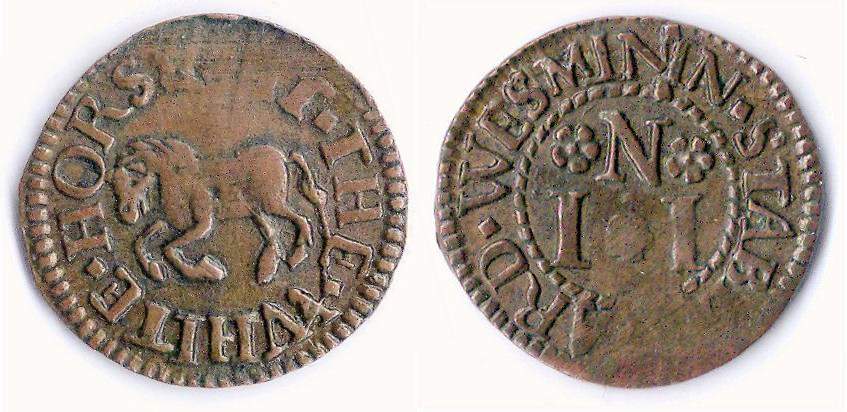
A farthing token issued in the name of the White Horse in Stable Yard, Westminster

A farthing token issued in the name of the White Horse in Stable Yard, Westminster

The above copper farthing measures 16.3 mm and weighs 1.20 grams. It was issued in the name of a tradesman operating from premises marked by the sign of the White Horse in Stable Yards, St. Margaret’s Parish, Westminster.

Obverse: (rosette) AT.THE.WHITE.HORSE , around the depiction of a horse running left.

Reverse:IN. STABLE.YARD.WESTMIN. , around twisted wire inner circle, a triad comprising I | (rosette) N (rosette) | (rosette) I , within.

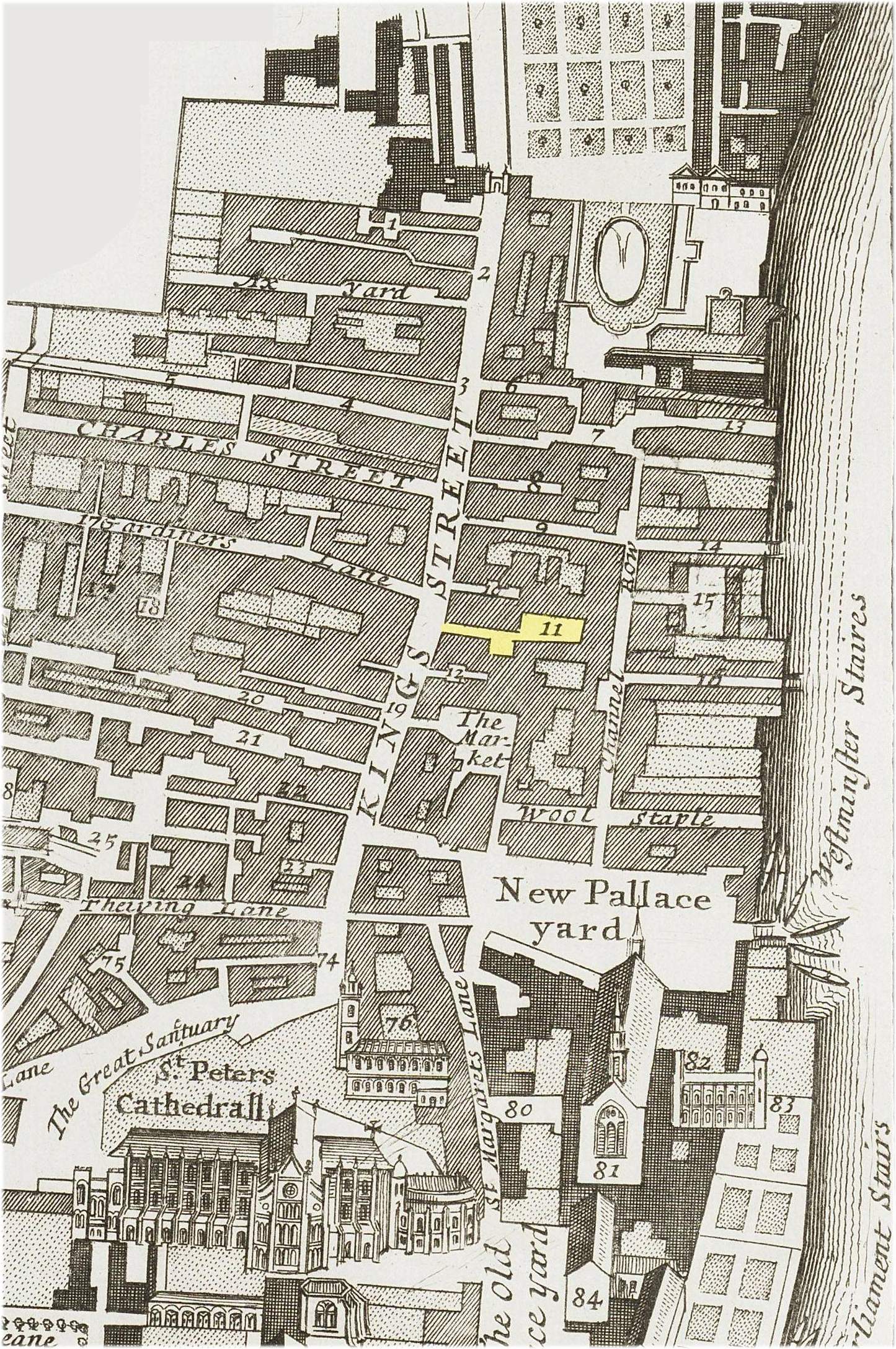
Part of the Parish of St. Margaret's, Westminster showing the location of Stable Yard (c.1720)

Part of the Parish of St. Margaret’s, Westminster showing the location of Stable Yard (c.1720)

Since before the 17th century the sign of the White Horse was commonly used by inns and taverns and it is highly likely that the token in question was issued by such an establishment located in Stable Yard off Kings Street. The token’s issuer (i.e. Mr. and Mrs. I. or J. N.) have not as yet been identified. An examination of the Hearth Tax returns for Stable Yard from 1666 indicates no residents with initials which fit those in the triad on the token’s reverse. On stylistic grounds it is likely that the farthing token in question was most likely issued several years before the mid 1660s so it is possible that its issuers had moved on by the time of the 1666 Hearth Tax assessment.

4 Comments

Filed under Tokens from West of the City Walls